
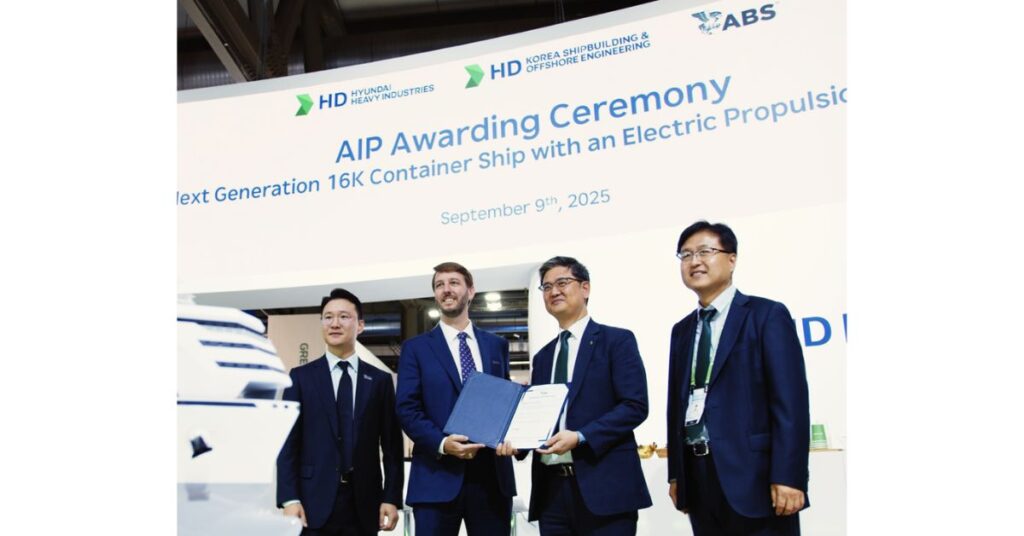
HD Hyundai Heavy Industries (HD HHI) and HD Korea Shipbuilding & Offshore Engineering (HD KSOE), affiliates of South Korea’s HD Hyundai, have received Approval in Principle (AiP) from the American Bureau of Shipping (ABS) for the concept design of a 16,000 TEU containership equipped with an electric propulsion system.
ABS conducted the design review in line with class requirements, covering the vessel’s power system, including generation, conversion, and propulsion motors.
Joshua Divin, Senior Vice President, Marine Business Development at ABS, said:
“ABS, HD KSOE and HHI share a commitment to leveraging our combined resources and expertise to advance electrical applications in the maritime industry. This AIP is a milestone achievement, and we are proud to work alongside KSOE and HHI to help safely integrate electric propulsion technologies into large seagoing vessels.”
Byoung-Hun Kwon, Head of the HD KSOE Electrification Center, added:
“This achievement represents a strategic step toward meeting the International Maritime Organization’s (IMO) 2050 carbon-neutral target. We will continue to strengthen the trust of global shipping companies by developing eco-friendly and high-efficiency ship technologies at the group level.”
The AiP marks the conclusion of the project’s first phase. A second phase, planned for 2026, will include the application of energy storage systems and high-efficiency propulsion drives as part of efforts to advance the commercialization of zero-carbon ship technologies.
Earlier in 2025, ABS also granted AiP to HHI and KSOE for the concept of a floating small modular reactor (SMR) unit designed to generate electricity offshore and nearshore, supporting port facilities and onshore communities. At the time, Patrick Ryan, Senior Vice President and Chief Technology Officer of ABS, commented:
“Floating nuclear power facilities show promise in supporting power grids, microgrids, industrial and port operations, data centers, and other uses. Additionally, today’s advanced nuclear technology has a different risk profile from traditional reactor technology with state-of-the-art designs and with lower enrichment fuels, making commercial offshore and maritime applications more viable.”
Recent Posts
HYBRID
GRSE Signs ₹1,032-Crore ONGC Contract for Four Hybrid Offshore Supply Vessels
EV
Energy In Motion Opens ₹500-Crore Electric Truck Plant in Pune
Fuels
Aegis Logistics Commissions 35,000-Tonne LPG Bottling Plant at JNPA