
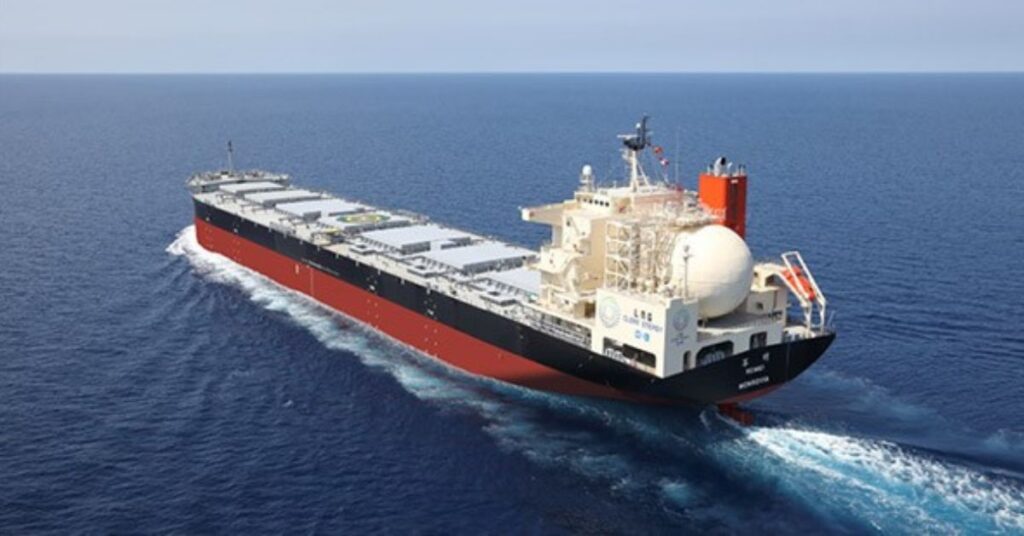
09 October 2025 | Tokyo — A consortium comprising Mitsui O.S.K. Lines (MOL), Kanadevia Corporation, and Yanmar Power Products, a subsidiary of Yanmar Holdings, has achieved a 98% reduction in methane slip during onboard trials of liquefied natural gas (LNG)-fueled vessels.
The results mark a major step forward in efforts to curb greenhouse gas emissions from LNG-powered ships under Japan’s Green Innovation Fund Project: “Development of Next-Generation Vessels,” administered by the New Energy and Industrial Technology Development Organization (NEDO).
Six-year project targets methane emissions from LNG engines
The partners have been jointly developing methane slip reduction technology for LNG-fueled engines through catalyst and engine improvements, with full-scale demonstration trials beginning in May 2025. The initiative spans six years (2021–2026) and initially targeted a 70% reduction in methane slip. The project also aims to become the first to achieve the social implementation of methane slip reduction technology in the maritime industry.
According to MOL, land-based tests previously conducted under the program achieved a 93.8% reduction at 100% engine load, results that were verified by classification society Nippon Kaiji Kyokai (ClassNK). Following the successful land trials, the consortium adapted the system for onboard testing.
Real-world trials deliver breakthrough results
Sea trials began in May 2025 on the LNG-powered coal carrier Reimei, operated by MOL, on routes between Japan and Australia. The trials were conducted under real operating conditions, including variable environmental factors and fluctuating engine loads.
During these tests, the system demonstrated a 98% reduction in methane slip at a 75% load, representing a significant improvement in real-world conditions compared to earlier controlled trials.
MOL stated that the partners are working to commercialize methane slip reduction systems for early deployment, aiming to support broader greenhouse gas mitigation efforts within the maritime sector.
The company added that the initiative aligns with Japan’s long-term goal of developing next-generation, low-emission vessel technologies to accelerate decarbonization in international shipping.
Recent Posts
Biofuels
WinGD Ethanol-Fuelled Engine Completes First In-Service Voyage on Maersk Vessel
Power & Propulsion
Norsepower Rotor Sails Installed on Airbus Cargo Ship Spirit of Toulouse
EV
Estonia Electric Ferry to Combine Steerprop Propulsion with Battery Power