
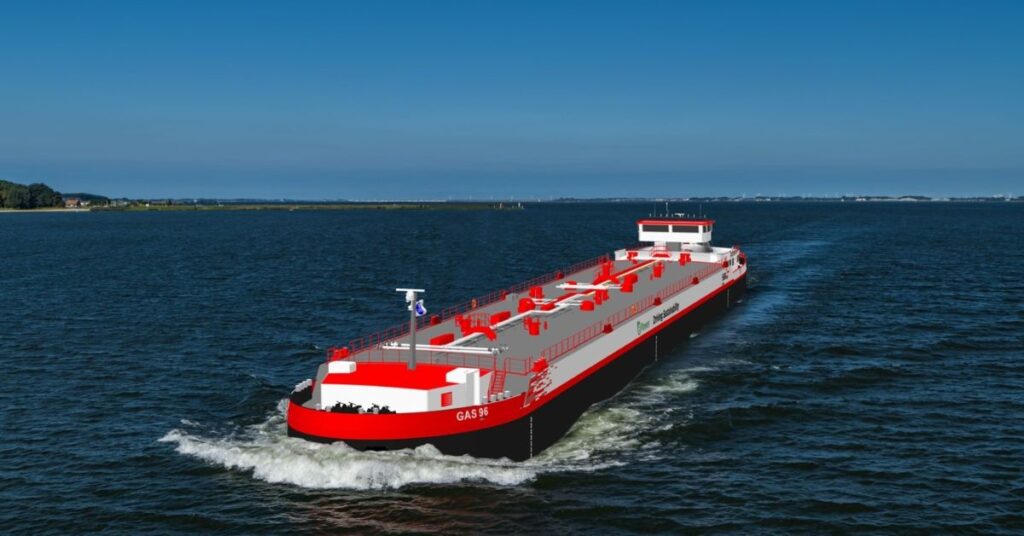
German shipping and logistics company Häfen und Güterverkehr Köln AG (HGK Shipping) has officially named its latest diesel-electric, future-fuel-ready gas tanker, Gas 96, in Rotterdam on October 9, 2025.
The vessel marks HGK Shipping’s third gas tanker optimized for shallow-water operations and equipped with a hybrid diesel-electric propulsion system designed to accommodate future clean fuels.
Vessel Construction and Capabilities
The Gas 96 was constructed in two stages — the hull was built at Severnav shipyard in Romania, while the superstructure and final outfitting were completed at De Gerlien van Tiem shipyard in the Netherlands.
Developed at HGK Shipping’s Design Center, the 110-meter-long and 15-meter-wide vessel features four cargo tanks with a total capacity of 3,256 cubic meters. The vessel’s rudder propellers enable it to operate efficiently even under extreme water level conditions.
According to HGK Shipping, Gas 96 can carry over 300 tons of cargo at a draught of just 1.20 meters, ensuring supply reliability during low-water phases on the Rhine. Under normal river conditions, it can transport more than 2,500 tons per journey.
Operational Role
The new gas tanker will immediately begin service on the Rhine route between Rotterdam, Antwerp, and Cologne, transporting liquefied gases under pressure for LyondellBasell (LYB), as part of a long-term charter agreement.
Industry Collaboration and Design for Future Fuels
Speaking at the naming ceremony, Yarelis Hernandez, Vice President of Global Intermediates & Derivatives Manufacturing at LyondellBasell, highlighted the partnership’s focus on innovation and adaptability.
“Within our close working relationship with HGK Shipping, we’ve repeatedly become aware of how our long-standing partner is meeting our needs with convincing ideas that provide solutions in an environment that’s constantly changing. The ‘GAS 96’ is a clear example of this innovative and cooperative approach,” Hernandez said.
“Saving resources by using sustainable logistics and a high degree of reliability for supplies are crucial goals in supply chain management for our production and that of our joint venture partner, Covestro.”
Anke Bestmann, Managing Director of HGK Gas Shipping GmbH, noted that Gas 96 was designed with future energy transition needs in mind.
“The ‘GAS 96’ is not just a tanker for the present time, but also one for the future. Goods that will need to be transported in future, such as ammonia, and fuel systems that are just being developed, such as methanol, have already been taken into consideration with this vessel design,” Bestmann said.
“In addition, the power management system on the new vessel reduces fuel consumption and waste gas emissions, as it already adapts the power that’s made available to the output that’s required.”
Bestmann added that the vessel was developed to meet the specific requirements of LyondellBasell and Covestro, emphasizing HGK Shipping’s focus on providing innovative and sustainable logistics solutions for the chemical industry.
Towards Greener Inland Shipping
The launch of Gas 96 reflects a broader trend in Europe’s inland shipping sector toward future-fuel-ready vessel designs, capable of transitioning to ammonia, methanol, and other low-emission fuels as they become commercially viable.
HGK Shipping’s latest addition is expected to play a key role in advancing the decarbonisation of inland waterway logistics and ensuring more resilient supply chains along the Rhine corridor.
Recent Posts
Biofuels
WinGD Ethanol-Fuelled Engine Completes First In-Service Voyage on Maersk Vessel
Power & Propulsion
Norsepower Rotor Sails Installed on Airbus Cargo Ship Spirit of Toulouse
EV
Estonia Electric Ferry to Combine Steerprop Propulsion with Battery Power