The Los Angeles–Long Beach–Shanghai Green Shipping Corridor (GSC) has reported notable advancements in improving vessel energy efficiency, port electrification, and alternative fuel bunkering, according to its second Annual Progress Report.
The trans-Pacific initiative, facilitated by C40 Cities, connects two of the world’s largest port complexes and is designed to accelerate the decarbonization of global maritime transport. The latest report highlights measurable progress in reducing emissions and expanding green infrastructure across both sides of the Pacific.
Full Shore Power Electrification and Green Fuel Deployment
The corridor has now achieved 100% shore power electrification for container vessels across the Ports of Los Angeles, Long Beach, and Shanghai, enabling ships to plug into land-based electricity while at berth. This development is expected to significantly reduce dockside emissions and improve local air quality.
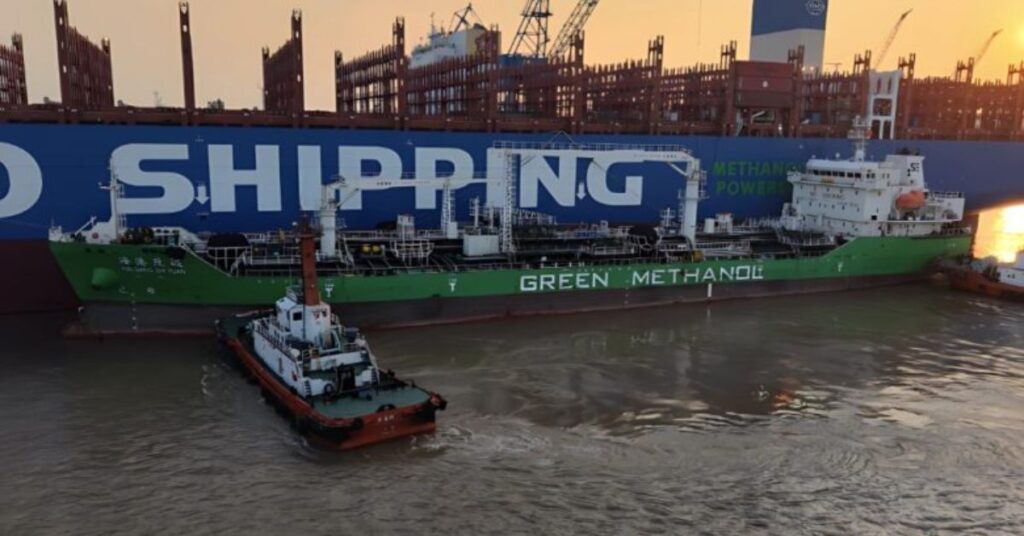
In parallel, the corridor has expanded the use of low-lifecycle carbon fuels, with more vessels capable of operating on green methanol and other clean alternatives. In Shanghai, more than 47,000 tons of green methanol were bunkered — marking China’s first domestic green methanol linkage.
At the U.S. ports, a clean fuels study was launched to assess future fuel pathways and infrastructure requirements for scaling sustainable bunkering operations.
Collaborative Framework and Working Groups
In March 2025, corridor partners convened in person at the Port of Long Beach to review progress and define the next phase of collaboration. During this meeting, stakeholders reaffirmed their shared goals and developed a phased metrics framework to guide ongoing measurement and transparency:
- Phase 1: Develop ship-based and port-based deployment metrics.
- Phase 2: Establish ship-based and port-based activity metrics.
- Phase 3: Create indicative emission reduction metrics.
Throughout 2025, collaboration continued through dedicated working groups on Ports, Carriers, Energy Supply, and Metrics & Evaluation.
The Ports Working Group completed electrification efforts and continued to coordinate port-level emissions reduction measures.
The Carriers Working Group prepared fleets for the transition to zero-emission operations, following the first green methanol container ship voyage along the corridor in 2024.
The Energy Supply Group finalized a fuel demand and supply study, reviewed fuel standard proposals for 2026 implementation, and monitored global clean fuel policy developments.
Meanwhile, the Metrics & Evaluation Group formalized a three-phase monitoring framework to track progress on fuel use, infrastructure deployment, and emissions outcomes.
Next Steps and Regulatory Alignment
Looking ahead, the GSC’s next phase will focus on addressing emerging challenges — particularly aligning with the International Maritime Organization’s (IMO) Net Zero Framework, and managing the evolving dynamics of clean marine fuel supply and demand. Corridor partners aim to maintain progress toward a fully decarbonized trans-Pacific shipping route by 2030, leveraging coordinated policy actions, industry investment, and transparent performance tracking.
Recent Posts
HYBRID
GRSE Signs ₹1,032-Crore ONGC Contract for Four Hybrid Offshore Supply Vessels
EV
Energy In Motion Opens ₹500-Crore Electric Truck Plant in Pune
Fuels
Aegis Logistics Commissions 35,000-Tonne LPG Bottling Plant at JNPA