

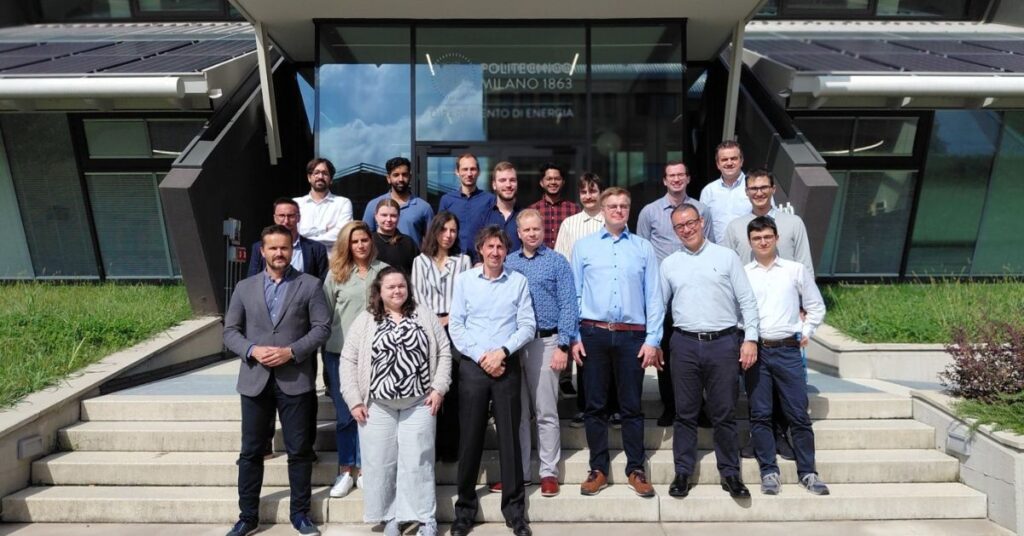
The EU-funded MARPOWER project (Efficient Zero-Emissions Gas Turbine POWER System for MARitime Transport) has reported notable progress in its first year of development, moving closer to delivering next-generation clean energy solutions for the maritime industry.
The initiative aims to address one of the shipping sector’s most urgent challenges — decarbonization. Shipping currently accounts for nearly 3% of global greenhouse gas (GHG) emissions, a figure projected to rise without rapid technological intervention. MARPOWER’s objective is to design a gas-turbine-based energy conversion system that operates with hydrogen and other net-zero fuels such as ammonia, green methane, and green methanol, supporting the sector’s transition to low-emission operations while maintaining performance and reliability.
Progress in Advanced Turbomachinery and Energy Systems
During its first year, the MARPOWER consortium, comprising eleven partners, has moved the project from conceptual design to detailed technical definition, laying the groundwork for component prototyping and testing.
Core power system and turbomachinery:
The team has advanced the design of the electrical generator, optimizing geometry and thermal performance to meet the demanding conditions of marine environments. The first high-pressure (HP) shaft has been designed with active magnetic bearings (AMBs) to support high-speed operation with reduced wear and energy loss.
Compressor and turbine designs, including a novel internal cooling system for turbine blades capable of withstanding temperatures up to 1200°C, have been completed. Work is also underway on combustion chamber prototypes, supported by computational fluid dynamics (CFD) simulations and upgraded facilities for hydrogen testing.
Heat recovery systems:
A new recuperator system with optimized heat surface geometry has been developed using Finite Element Analysis (FEA) and CFD to ensure durability under extreme gradients and vessel motion. Additionally, design work has started on a Waste Heat Recovery (WHR) boiler to enhance overall energy efficiency.
Digital twin development:
A digital twin platform has been launched to simulate and validate the full energy system. By integrating component models and operational data, the tool enables predictive performance analysis, reducing technical and financial risks before physical prototyping.
Fuel flexibility and safety:
The project team has evaluated hydrogen, methanol, and ammonia as potential fuels, comparing their techno-economic performance and health, safety, and environmental (HSE) profiles. The research covers flammability, toxicity, handling, and regulatory compliance, ensuring MARPOWER’s system can adapt safely to various fuels.
Regulatory and sustainability framework:
The consortium has developed technical standards, safety guidelines, and regulatory mappings aligned with maritime certification processes. Early Life Cycle Assessment (LCA) and Life Cycle Costing (LCC) analyses are underway to assess the system’s long-term environmental and economic performance.
Commercial pathway:
Several Key Exploitable Results (KERs) have been identified, and strategies are being formulated to facilitate market deployment of MARPOWER technologies once validated.
Supporting a Climate-Neutral Maritime Transition
“The progress achieved during this first year shows that advanced turbomachinery, new energy recovery technologies, and the use of sustainable fuels can be combined to support the development of next-generation clean power systems for shipping,” said Professor Jussi Sopanen, Coordinator of the MARPOWER project at LUT University. “This strengthens our confidence that the project is on track to deliver practical pathways to help the maritime sector cut emissions while maintaining efficiency and reliability.”
Maritime transport remains one of the hardest sectors to decarbonize due to its dependence on heavy fuels, long asset lifespans, and high energy intensity. As the International Maritime Organization (IMO) and EU tighten emission regulations, shipowners face growing pressure to adopt technically viable and cost-effective solutions.
The MARPOWER project’s approach — combining fuel flexibility, digital validation, and regulatory readiness — aims to offer a scalable solution that supports both new builds and retrofits, aligning with global climate goals.
Next Steps
In its second phase, MARPOWER will focus on integrating subsystem designs into a cohesive gas turbine setup, alongside validating active magnetic bearings, turbine cooling, and recuperator durability under operational conditions.
The project will also finalize combustion studies for alternative fuels and consolidate its digital twin platform to ensure system-level optimization. Alignment with safety standards and certification pathways will remain central to upcoming activities.
With prototype manufacturing and testing planned for the next stages, MARPOWER is progressing toward its goal of delivering an efficient, reliable, and low-emission power system tailored for the future of maritime transport.
Recent Posts
Fuels
Lloyd’s Register and MARIC unveil tri-fuel-ready tanker concept designed to navigate fuel uncertainty
Ammonia Power & Propulsion
Fraunhofer IMM develops system solution for ammonia propulsion in inland shipping
Ports & Harbours
V.O. Chidambaranar Port identified as potential green shipping corridor node on India-Europe route