

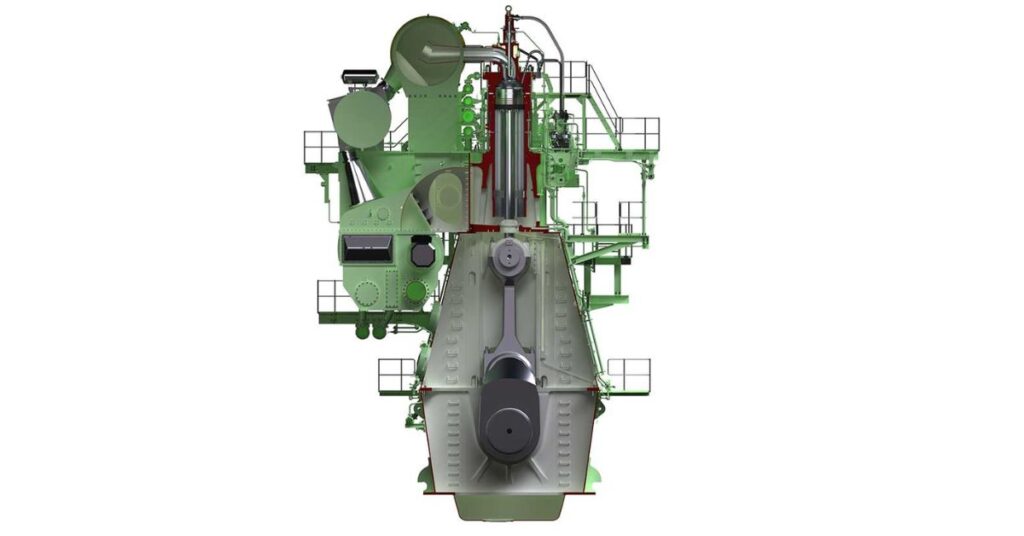
Everllence has announced the successful conversion of an Everllence B&W S90 two-stroke engine to dual-fuel methanol operation, following sea trials of COSCO SHIPPING LINES’ 20,000+ TEU container vessel COSCO SHIPPING LIBRA. The vessel’s original 11S90ME-C engine was upgraded to an 11S90ME-LGIM (Liquid Gas Injection Methanol) configuration — marking the first retrofit of its kind for this large-bore engine type.
Collaboration and Technical Scope
The project was executed in collaboration with COSCO SHIPPING HEAVY INDUSTRY, with Everllence PrimeServ — the company’s after-sales division — leading the effort from concept through completion. The retrofit program included engineering, project management, installation, commissioning, and extensive sea trials to validate performance.
To support the development process, Everllence commissioned a dedicated 4S90 testbed engine in Japan in early 2025. The testbed was used to verify methanol combustion characteristics and optimize the system under real operating conditions before applying the technology to the COSCO SHIPPING LIBRA.
Michael Petersen, Senior Vice President and Head of Everllence PrimeServ, Denmark, said:
“We’re proud to support COSCO SHIPPING LINES and COSCO SHIPPING HEAVY INDUSTRY — and the maritime industry as a whole — in taking this significant step toward decarbonising shipping. This milestone highlights COSCO SHIPPING LINES’ role as a first mover and presents a practical path for reducing emissions from Everllence S90 engine vessels. It also showcases Everllence’s capability to deliver large-scale retrofit projects. With 26 dual-fuel conversions already completed and an even larger pipeline across various alternative fuels, shipowners can trust Everllence to deliver retrofit solutions at scale.”
Expanding Retrofit Opportunities
The success of the COSCO SHIPPING LIBRA retrofit demonstrates the technical and commercial feasibility of converting large-bore engines to methanol fuel. According to Everllence, more than 300 vessels worldwide are currently equipped with S90-class engines, making them potential candidates for similar conversions.
Petersen added:
“While the journey toward full decarbonisation will require collaboration across the industry, this achievement demonstrates that large-scale conversions are both technically proven and commercially viable. This opens a practical pathway towards accelerating the maritime energy transition together with our customers.”
Towards a Methanol-Ready Fleet
The project aligns with the broader maritime sector’s push to adopt low-carbon and alternative fuel technologies. Methanol, in particular, is emerging as a leading transitional fuel due to its relative ease of storage, established supply chain, and compatibility with retrofitted engine designs.
By proving that existing large-bore engines can be upgraded for methanol operation, Everllence’s latest achievement is expected to influence retrofit strategies across the container shipping sector and beyond.
Recent Posts
Power & Propulsion
bound4blue secures Bureau Veritas Design Assessment for Model 3-24 eSAIL
Marine
HMM signs $3.5 billion long-term shipping contract with Vale
Hydrogen
Japan Engine completes factory tests of Hydrogen-fuelled marine engine