

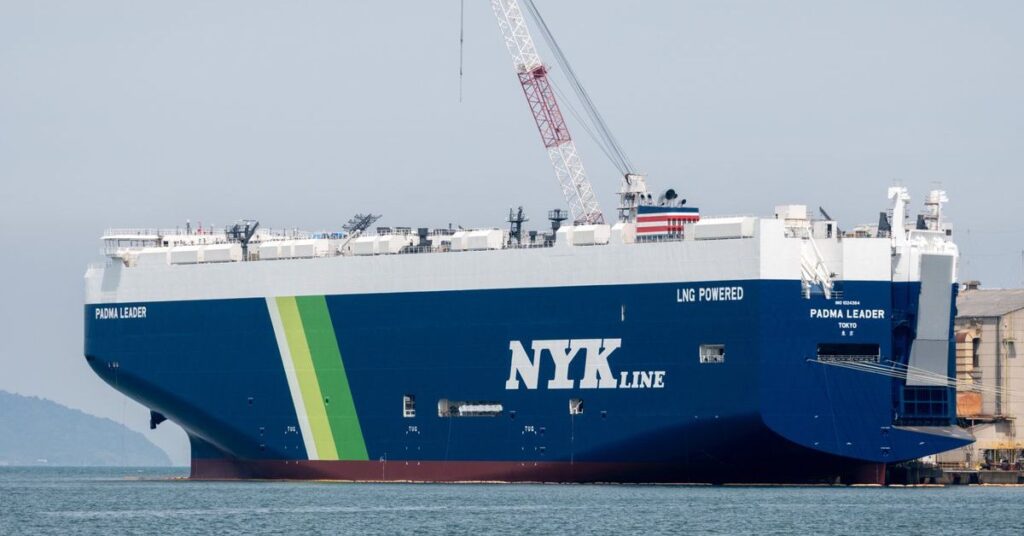
Japanese shipping major Nippon Yusen Kabushiki Kaisha (NYK Line) has taken delivery of its newest liquefied natural gas (LNG)-powered pure car and truck carrier (PCTC), the Padma Leader, from Imabari Shipbuilding Group. The vessel, built at Tadotsu Shipbuilding Co. Ltd., a subsidiary of the Imabari Group, strengthens NYK Line’s growing fleet of low-emission car carriers.
LNG-Fueled Design to Cut Emissions by Up to 30%
The Japan-flagged Padma Leader is a 7,000 CEU, 18,505 dwt vessel designed to transport vehicles with improved energy efficiency and lower emissions. Measuring 199.93 meters in length and 38 meters in beam, the ship has been classed by ClassNK and is capable of running on LNG — one of the most widely available alternative fuels currently used in international shipping.
According to Imabari Shipbuilding, the LNG propulsion system is expected to reduce carbon dioxide (CO₂) emissions by 25–30% compared to conventional heavy fuel oil. The vessel is also designed to completely eliminate sulfur oxide (SOx) emissions and achieve an 80–90% reduction in nitrogen oxides (NOx) through the use of LNG fuel combined with an exhaust gas recirculation (EGR) system. The EGR technology reduces NOx emissions by reintroducing part of the exhaust gas back into the combustion process.
Improved Fuel Efficiency Through Boil-Off Gas Utilization
The Padma Leader features a system that allows boil-off gas (BOG) generated during LNG storage to be redirected and reused in the vessel’s generators and boilers. This setup improves fuel efficiency and contributes to additional emission reductions.
Strengthening NYK Line’s Green Fleet
The Padma Leader joins NYK Line’s expanding fleet of next-generation, energy-efficient vessels, which form part of the company’s broader decarbonisation strategy. NYK has been steadily introducing LNG-powered PCTCs to support its green transition roadmap and align with IMO decarbonisation targets.
The delivery of Padma Leader follows NYK’s ongoing efforts to advance cleaner shipping solutions through the adoption of LNG, biofuels, and future-ready propulsion systems capable of accommodating ammonia or hydrogen as marine fuels in the coming years.
Recent Posts
Marine
WinGD Orders Four Dual-Fuel Engines for Polaris Shipping’s Newcastlemax Fleet
EV
Jio-bp, DRIVN sign MoU to expand commercial EV charging infrastructure in India
Policy
DGMA discusses marine engine manufacturing partnership with WinGD in India