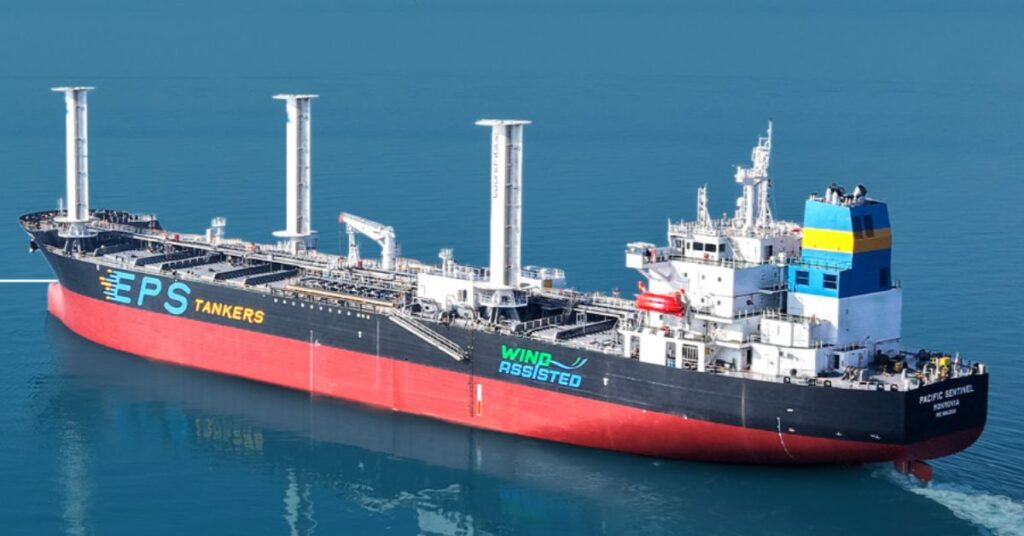
The Global Centre for Maritime Decarbonisation (GCMD) has released a study outlining a standardised approach for assessing the performance of wind-assisted propulsion systems (WAPS), following a four-month case study on Eastern Pacific Shipping’s (EPS) medium-range tanker Pacific Sentinel.
The paper, “Quantifying energy savings from wind-assisted propulsion systems (WAPS),” validates the methodology using operational data collected after three 22-metre suction sails were installed on the vessel in March 2025. Performance was monitored from mid-May to mid-September as the tanker operated on the spot market across the Americas.
Methodology for Real-World WAPS Performance Assessment
GCMD’s method consists of three key components:
- High-frequency data collection
Sensors recorded weather data, power consumption, vessel speed, and heading every 15 seconds. - On-off testing and screening protocol
Tests were conducted in line with 2024 International Towing Tank Conference (ITTC) and 2025 DNV guidelines. - Statistical analysis
Performance and operational data were analysed to isolate the specific energy contribution of the suction sails.
Both manual on-off tests and automatic transitions triggered by the sails’ control system were considered in the study, yielding statistically conclusive results under varying real-world conditions.
Findings from the Pacific Sentinel Case Study
Valid transitions and test sample
Screening all transitions for operational stability produced 203 valid transitions, forming the basis for measuring instantaneous power savings.
Mean power savings observed
During the monitoring period, the vessel predominantly encountered near-headwind conditions. Under these circumstances, the mean instantaneous power savings were 7.2%, with a 95% confidence interval of 6.2% to 8.2%.
Higher savings in favourable wind
Savings increased significantly when wind conditions aligned more favourably. The study recorded maximum instantaneous savings of 28.1% at an apparent wind angle of 47° and wind speed of 15.3 m/s.
Instances of negative savings
The analysis notes occasional negative savings, reaching –14.0%, in strong headwind environments. These were statistically rare outliers, falling three standard deviations from the observed mean.
Establishing a Framework for WAPS Evaluation
The methodology is designed to isolate environmental and operational variability, offering a consistent and transparent framework for validating WAPS performance under operational conditions.
Towards Scalable Energy-Savings Data and Financing Models
GCMD states that the dataset produced through this approach can help strengthen confidence among owners, charterers, and investors. A growing database may also support the development of technology-specific savings factors and financing mechanisms such as pay-as-you-save models, linking capital recovery to verified energy performance.
Recent Posts
Ammonia
Maersk Tankers Ammonia Retrofit Project Advances Towards EU Support
Policy
EU Maritime Innovation Projects Advance in €3.4-Billion Funding Selection
Policy
Shanghai–Melbourne Green Shipping Corridor Sets 2035 Vessel Deployment Goal