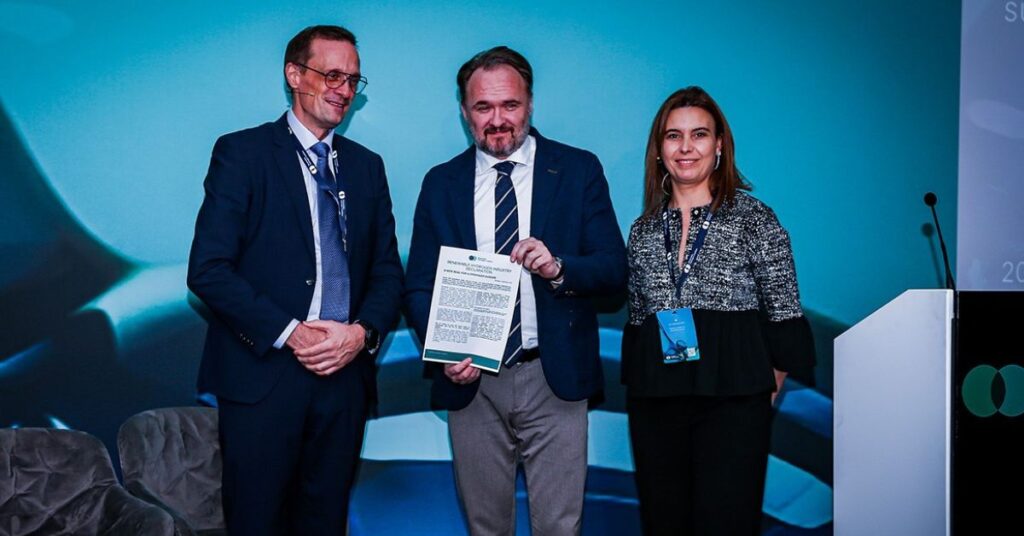
A coalition of companies from Europe’s renewable hydrogen sector has issued a joint declaration urging policymakers to adopt what it calls a “New Deal for a Stronger Europe.” The appeal comes as the EU reaches the midpoint of its Hydrogen Strategy timeline, prompting industry leaders to call for faster implementation, clearer long-term targets, and updated support mechanisms to drive project investments.
Sector Warns of Slow Uptake as Europe Misses 2024 Hydrogen Strategy Benchmark
The declaration notes that the EU’s 2020 Hydrogen Strategy aimed for 6 GW of electrolyser capacity by 2024. According to the European Hydrogen Observatory, Europe currently has around 600 MW operational and 3 GW under construction, significantly below the initial goal.
Industry representatives argue that Europe must reinforce its commitment to renewable hydrogen to ensure a level playing field with low-carbon alternatives. This includes maintaining renewable hydrogen prioritisation across policy frameworks, speeding up adoption of binding targets, and offering clear compliance pathways through 2040.
Hydrogen Sector Positions Itself as Strategic Asset for Europe
The coalition emphasises the role of renewable electrolytic hydrogen in enhancing energy resilience, reducing fossil fuel dependence, and supporting hard-to-electrify sectors such as steelmaking, aviation, and shipping. The declaration states that renewable hydrogen can also provide grid flexibility, reduce curtailment, and create industrial opportunities across the continent.
Electrolyser manufacturing capacity in Europe has expanded from 1 GW a few years ago to an expected 10 GW soon, with 15 GW projected by 2026. The coalition says these developments underline the sector’s readiness to scale, but warns that viable business cases remain limited without stronger policy support.
If enabling measures are put in place, coalition members say they could collectively bring up to 18 GW of renewable hydrogen production capacity online between 2026 and 2032.
Industry Issues Five Key Policy Requests
The declaration outlines five areas where the sector seeks action from EU policymakers:
1. Infrastructure Build-Out
The coalition calls for accelerated development of electricity and hydrogen infrastructure, designating such projects as being of “overriding public interest.” It seeks fast-track permitting, priority grid connections for mature projects, and integrated planning between electricity and hydrogen networks.
2. Funding Framework Fit for Scale
The industry urges the EU to strengthen the European Hydrogen Bank, making deadlines more flexible for projects delayed by infrastructure or permitting issues. It also recommends combining unused EU funds to increase the Bank’s budget, arguing the sector requires €6–8 billion per auction to meet RED III RFNBO targets.
3. Demand-Side Incentives
The coalition identifies an “offtake problem,” calling for binding minimum quotas for green materials in public procurement—covering sectors such as automotive, defence, and construction. It also proposes preferential taxation and clearer labelling to distinguish products made using renewable energy.
4. Improving Supply Conditions
The industry seeks targeted adjustments to the RFNBO Delegated Act, including extending the transitional phase for additionality until 2026 and recognising supported renewable assets as eligible for RFNBO production. It also calls for ensuring state-aided RFNBO projects count toward legal targets.
5. Lowering Electricity Costs
Given that electricity makes up 60–70% of renewable hydrogen production costs, the declaration asks for reduced taxes and levies on renewable electricity and hydrogen. It notes that electricity faces significantly higher levies than natural gas in many EU states.
A Mutual Commitment
In return for policy support, the sector pledges to accelerate investments and final investment decisions (FIDs) for projects nearing maturity. The declaration states that Europe has the industrial capacity and expertise needed to build a globally competitive renewable hydrogen industry, but requires coordinated action between policymakers and industry to realise this potential.
Recent Posts
Ammonia
Maersk Tankers Ammonia Retrofit Project Advances Towards EU Support
Policy
EU Maritime Innovation Projects Advance in €3.4-Billion Funding Selection
Policy
Shanghai–Melbourne Green Shipping Corridor Sets 2035 Vessel Deployment Goal