
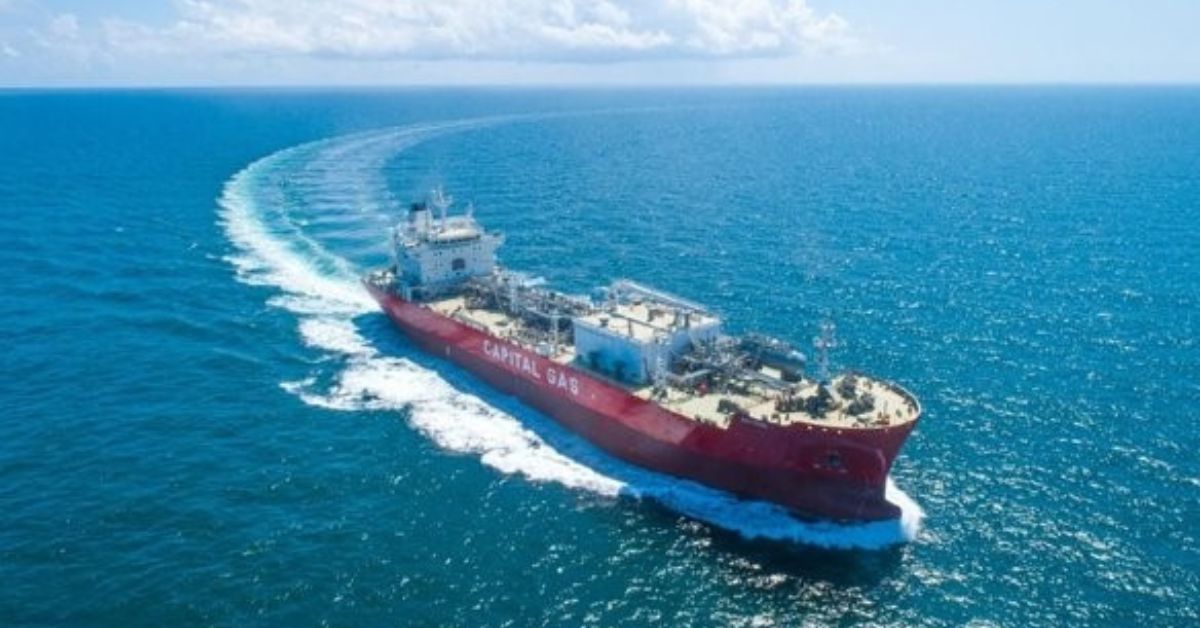
The first large-capacity vessel designed to support the capture, transport, storage and reuse of carbon dioxide has been completed, marking the emergence of a new shipping segment focused on carbon management logistics.
The 22,000 cubic metre vessel has been developed for charter operations and is capable of switching between liquefied CO₂ (LCO₂) transport and other gas cargos, including LPG, ammonia and selected petrochemicals. The design is intended to allow operators to deploy the ship across multiple trades as market conditions evolve.
The project is led by Greece-based Capital Maritime Group, which has launched a dedicated platform, Capital Clean Energy Carriers, to target the emerging carbon capture, utilisation and storage (CCUS) shipping market.
Vessel design and construction
Capital Clean Energy Carriers placed its initial order for two vessels in July 2023 with South Korea’s Hyundai Mipo Dockyard, later expanding the series to four ships. The vessels measure approximately 525 feet in length and are equipped with a semi-refrigerated gas carrier cargo system.
According to Capital, the ships “stand out for their versatility and optionality as they adapt to shifting market dynamics.”
The first vessel in the series, Active (27,926 dwt), was delivered on January 6 and has been immediately deployed on a six-month charter to transport LPG for an energy trading company. The charter includes an option for a further six-month extension. Active is registered in the Marshall Islands.
A new approach to LCO₂ shipping
Unlike earlier LCO₂ carriers that were purpose-built for specific projects—such as those linked to Norway’s Northern Lights carbon storage development—Capital’s vessels are owned by an established tanker operator and are designed for broader commercial deployment. In addition to cargo flexibility, the ships are intended to support multiple CCUS projects and conventional gas trades.
The new vessels are also significantly larger than earlier LCO₂ carriers, such as Northern Pioneer and sister ships, which are designed specifically for transport to Norwegian storage sites.
Market outlook for carbon capture transport
Capital Clean Energy Carriers has pointed to growing demand for shipping linked to carbon capture, utilisation and storage. The company estimates current global carbon capture capacity at around 50 million tonnes per year.
Citing data from the International Energy Agency, Capital said capture capacity could increase to approximately 430 million tonnes per year by 2030, while CO₂ storage capacity could reach around 670 million tonnes annually over the same period.
Fleet expansion plans
As a first mover in this segment, Capital Clean Energy Carriers said the vessels reflect its strategy to diversify beyond conventional tanker operations. The group’s fleet currently includes 12 LNG carriers in operation.
In addition, the company has nine LNG carriers, six dual-fuel medium gas carriers, and three handy LCO₂/multi-gas carriers on order, with deliveries scheduled between the second quarter of 2026 and the first quarter of 2029.
Recent Posts
HYBRID
GRSE Signs ₹1,032-Crore ONGC Contract for Four Hybrid Offshore Supply Vessels
EV
Energy In Motion Opens ₹500-Crore Electric Truck Plant in Pune
Fuels
Aegis Logistics Commissions 35,000-Tonne LPG Bottling Plant at JNPA