

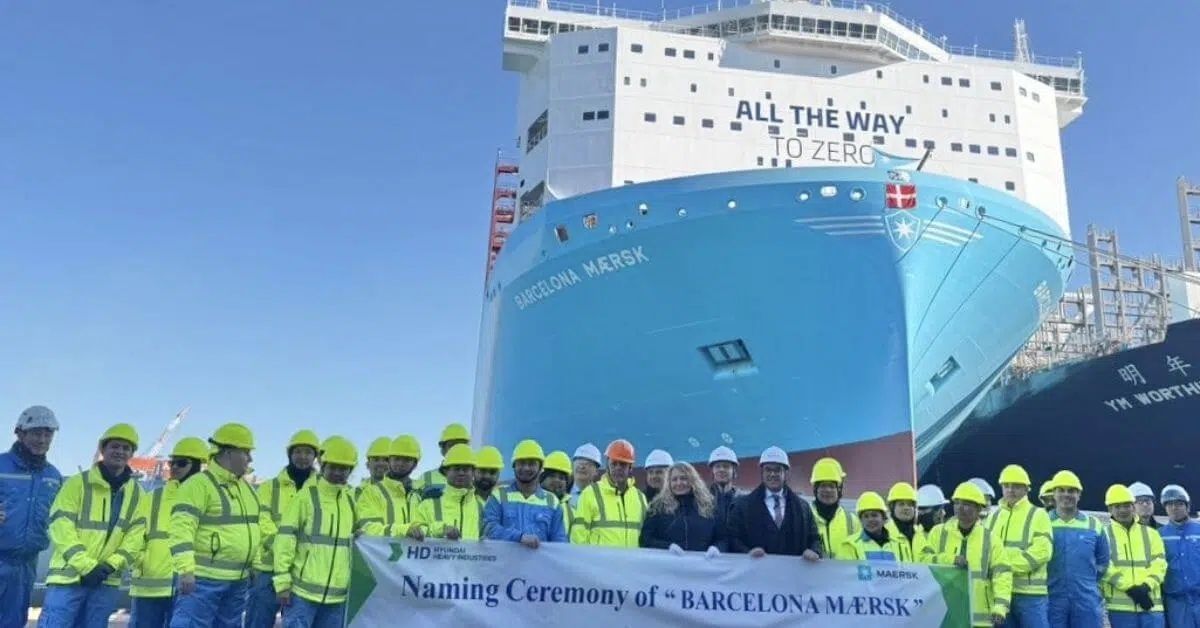
A.P. Moller–Maersk has taken delivery of Barcelona Mærsk, the sixth and final vessel in its 17,480-TEU dual-fuel methanol container ship series, completing the Equinox Mk-II newbuilding programme.
The vessel was handed over at the shipyard of HD Hyundai Heavy Industries in Ulsan, where it was constructed.
With the delivery of Barcelona Mærsk, the Danish container carrier now has around 19 methanol-capable vessels in operation, meeting a deployment target it had originally set for the end of last year.
Equinox Mk-II class
Barcelona Mærsk forms part of Maersk’s Equinox Mk-II class, which follows the earlier Ane Mærsk class with a capacity of 16,592 TEU. The Mk-II design features a wider beam and other design modifications, making these ships the largest methanol-powered vessels currently in Maersk’s fleet.
The ship was christened during a ceremony at the Ulsan yard. Maersk said the vessel was named by Berit Vincentz Andersen, a senior communications advisor from its Fleet Management and Technology team, in the presence of the crew, Maersk employees and representatives from the shipbuilder.
Propulsion and fuel capability
The container ship is designed to operate on both conventional marine fuels and methanol. It is powered by an eight-cylinder MAN B&W G95ME-C10.5-LGIM dual-fuel engine built by Hyundai-MAN.
The vessel is equipped with two methanol fuel tanks located forward of the engine room, with a combined capacity of approximately 16,000 cubic metres. When fully bunkered with methanol, the ship has a sailing range of up to 23,000 nautical miles, enabling full round voyages on major trade lanes such as the Asia–Europe AE3 service using alternative fuel.
Emissions and fuel strategy
Maersk has stated that the use of green methanol can reduce greenhouse gas emissions by up to 90 per cent compared with conventional fossil fuels, with potential savings of around 280 tonnes of carbon dioxide per day.
The company has set a target to achieve net-zero greenhouse gas emissions across its operations by 2040 and has identified methanol as a key fuel in this transition. It defines reduced-emission fuels as those delivering at least a 65 per cent reduction in lifecycle emissions compared with standard fossil fuels, based on a reference level of 94 g CO₂e per megajoule.
Alongside methanol-fuelled vessels, Maersk has also included LNG-powered newbuildings in its fleet plans, citing the need for fuel flexibility as the availability of scalable green fuel supply continues to develop.
Recent Posts
Fuels
Lloyd’s Register and MARIC unveil tri-fuel-ready tanker concept designed to navigate fuel uncertainty
Ammonia Power & Propulsion
Fraunhofer IMM develops system solution for ammonia propulsion in inland shipping
Ports & Harbours
V.O. Chidambaranar Port identified as potential green shipping corridor node on India-Europe route