
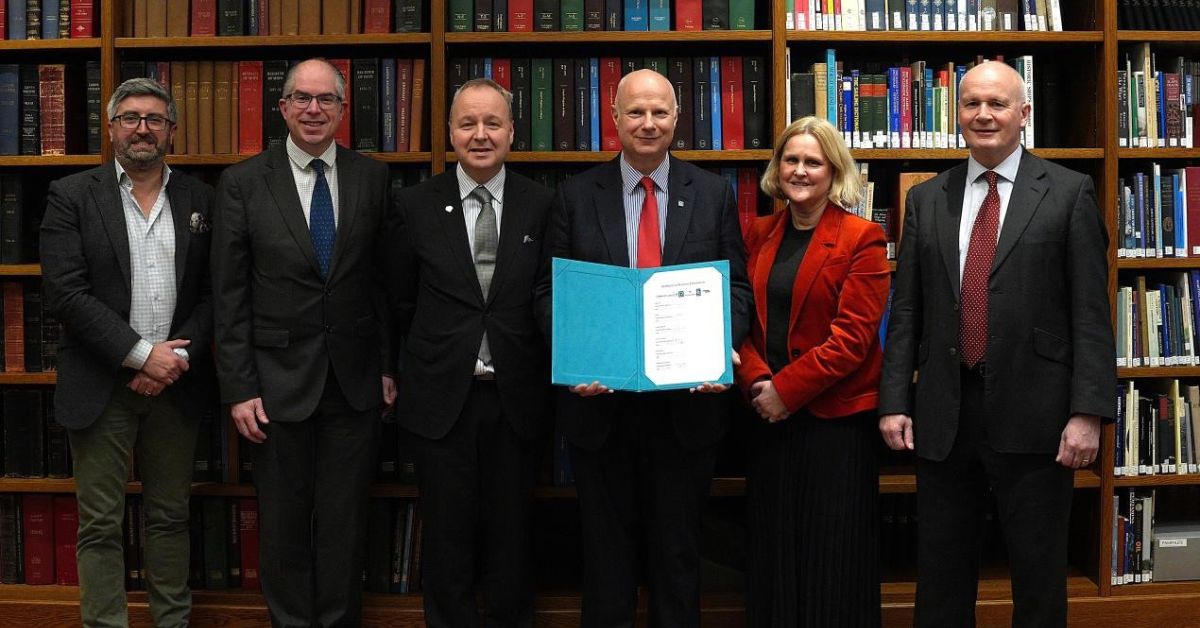
The UK has launched the Maritime Nuclear Consortium, a new industry-led initiative aimed at developing international standards for the safe, secure and commercially viable use of nuclear power in commercial shipping.
The consortium has been convened by Lloyd’s Register, which will act as lead organisation, safety authority and secretariat. It brings together stakeholders from the nuclear, maritime, insurance, legal and regulatory sectors to address technical, regulatory and commercial barriers to maritime nuclear propulsion.
Cross-sector membership
Core members of the consortium include Rolls-Royce, responsible for reactor design; Babcock International Group, covering ship design, construction and support; Global Nuclear Security Partners, focused on security and safeguards; law firm Stephenson Harwood, advising on legal and regulatory frameworks; marine insurer NorthStandard; and Lloyd’s Register in its classification and safety role.
The group is focused on adapting nuclear technologies—long used in naval applications—for use in commercial shipping, particularly through next-generation advanced modular reactors (AMRs).
Role of nuclear power in shipping decarbonisation
According to the consortium, maritime nuclear power offers the potential for zero-carbon propulsion with multi-year operating cycles between refuelling. Proponents argue this could allow ships to operate at full design speed without the efficiency penalties associated with slow steaming, while eliminating operational CO₂ emissions.
More than 700 nuclear reactors are currently in operation across naval fleets worldwide. The challenge, the consortium notes, lies in aligning nuclear technology with commercial shipping requirements, insurance frameworks and international maritime regulation.
Initial programme objectives
The consortium’s first programme will focus on five areas:
- Demonstrating a Statement of Design Acceptability (SODA) for a generic, site-licensed advanced modular reactor
- Developing a class certification framework integrating nuclear and maritime regulatory regimes
- Defining a security and safeguards architecture aligned with regulatory expectations
- Establishing pathways for insuring nuclear-powered commercial vessels
- Publishing guidance for industry and government to support early adoption
Industry perspectives
Nick Brown, CEO of Lloyd’s Register, said:
“Decarbonisation demands cleaner power, higher standards and a duty to the generations that follow. Nuclear is ready to meet that test.
“Used safely in naval fleets for decades, the next generation of advanced modular reactors brings tougher safeguards and the chance to bring nuclear power into everyday commercial shipping.
“If the UK leads on global standards, nuclear will mean more than zero-carbon ships. It will mean work in British shipyards, new business in the City, and lasting jobs for those who build, insure and sail the world’s fleet.”
Jake Thompson, Director of Rolls-Royce Advanced Modular Reactors, said:
“Energy transition is a growing priority across multiple industries and nuclear is increasingly seen as part of the solution.
“We believe that the multi-sector collaboration from the Nuclear Maritime Consortium is a critical first step in the UK leading the development of the future international code for nuclear-powered vessels.
“Rolls-Royce is one of the world’s only nuclear reactor vendors with full lifecycle experience and end-to-end capability to credibly deliver these advanced technologies; based on proven, reliable power solutions in use across our business today.”
Mike Salthouse, Head of External Affairs at NorthStandard, said:
“Insurance plays a critical role managing the risks associated with, and fostering confidence in, new technologies. At the heart of that confidence are people.
“Through our participation in the Maritime Nuclear Consortium, we will contribute not only technical knowledge but also human insight. We are helping shape the future of nuclear-powered shipping with a focus on safety, security, and accountability.”
Nick Tomkinson, Senior Partner at Global Nuclear Security Partners, said:
“Maritime nuclear will only succeed when safety, security and safeguards are considered together from the start.
“This guidance document helps first movers align maritime and nuclear frameworks, apply goal-based approaches where prescriptive rules are absent, and build the confidence required by regulators, insurers and the public.”
Kirsti Massie, Partner at Stephenson Harwood, added:
“Nuclear power has the potential to turbo-charge the UK’s energy transition and efforts to reduce carbon emissions. By bringing this Consortium together the UK has the opportunity to turn that potential into progress and set the global standards that can be used for generations to come.”
Maria Taboada, Marine Engineering Director at Babcock, said:
“The transition to nuclear-powered shipping is not just as a technological advancement, but a strategic move to secure the UK’s maritime leadership.
“Babcock is one of the core members of the consortium bringing decades of experience from naval nuclear programmes and will be responsible for the engineering and integration of nuclear technologies into a maritime vessel.”
Recent Posts
HYBRID
GRSE Signs ₹1,032-Crore ONGC Contract for Four Hybrid Offshore Supply Vessels
EV
Energy In Motion Opens ₹500-Crore Electric Truck Plant in Pune
Fuels
Aegis Logistics Commissions 35,000-Tonne LPG Bottling Plant at JNPA