

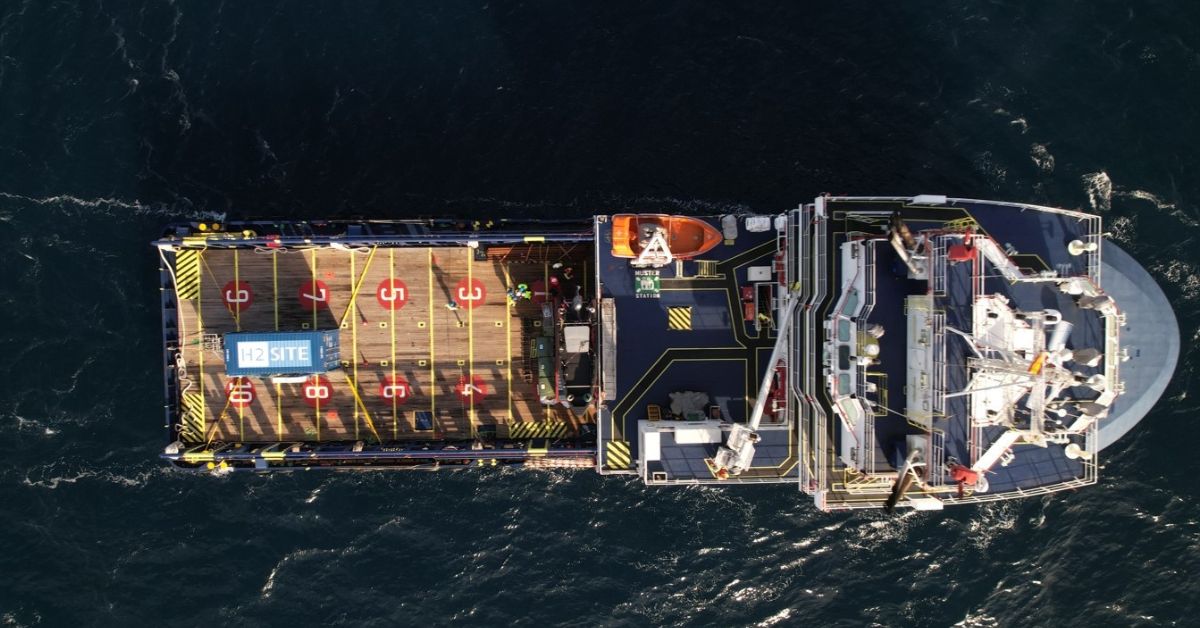
Spanish hydrogen technology company H2SITE has launched H2SITE Norway AS, a new subsidiary based in Bergen, to support the deployment of hydrogen-based solutions for maritime and offshore decarbonisation.
The move reflects H2SITE’s intention to work more closely with Norway’s maritime and offshore sectors, where shipowners and operators are assessing low- and zero-emission fuel pathways, including ammonia and hydrogen.
Technology background
H2SITE is headquartered in Bilbao, where its core technology is developed and manufactured. From its industrial facility in Loiu, Bizkaia, the company produces palladium-alloy membranes that are integrated into membrane reactor systems designed to convert hydrogen carriers back into hydrogen.
For ammonia-based applications, H2SITE has developed cracking systems capable of producing high-purity hydrogen that can be supplied directly to fuel cells or blended into internal combustion engines. The company positions this capability as relevant for maritime and offshore use cases, where fuel logistics, system integration and operational reliability are key considerations.
Why Norway
Norway is viewed by H2SITE as a suitable environment for the next phase of deployment due to its established maritime sector, climate policy framework and experience with first-of-a-kind projects. The country is already evaluating the use of ammonia onboard vessels in commercial settings.
With a local presence, H2SITE aims to collaborate directly with Norwegian shipowners, shipyards and technology providers to adapt its systems to specific vessel types and operating profiles.
From validation to implementation
According to the company, the decision to establish H2SITE Norway AS comes at a point where the technology has moved beyond validation and into implementation. Since 2023, H2SITE has built and operated ammonia cracking systems for more than 6,000 hours, including extended continuous operation. Maritime-oriented projects, including H2Ocean and APOLO, have focused on integration with fuel cells and engines.
In parallel, the company is developing megawatt-scale systems and has expanded manufacturing capacity to support early commercial projects.
Addressing maritime decarbonisation challenges
Decarbonising vessels such as RoRo ships, bulk carriers, platform supply vessels and tankers continues to present technical and operational challenges. While ammonia-to-power four-stroke engines are progressing toward commercial readiness, issues remain at low-load operation, including ammonia slip and the need for pilot fuel.
H2SITE’s approach involves onboard ammonia cracking to enable the storage of liquid ammonia while producing hydrogen for combustion enhancement or fuel-cell-based auxiliary power. The company sees hybrid configurations and full fuel-cell propulsion as potential pathways toward zero-emission vessel operation.
Regulatory developments are also influencing investment decisions. While global rules under the International Maritime Organization continue to evolve, regional measures such as FuelEU Maritime and the EU Emissions Trading System are already affecting fleet planning and are expected to tighten over time.
Next steps
H2SITE Norway AS is positioned as a platform for pilot and demonstration projects, with a focus on operating systems under realistic conditions and collecting operational data.
“The technology is proven; the priority now is implementation of the product and operational learning,” said Tomás Crespo, Maritime Business Development Manager at H2SITE Norway. “We are looking to work with Norwegian shipowners and shipyards that want to take a measured, forward-looking approach to decarbonisation.”
Over the coming year, the company expects its activities in Norway to centre on project execution, system deployment and collaboration with industry partners, as part of its broader effort to enable onboard hydrogen production for maritime propulsion and auxiliary power.
Recent Posts
Fuels
Lloyd’s Register and MARIC unveil tri-fuel-ready tanker concept designed to navigate fuel uncertainty
Ammonia Power & Propulsion
Fraunhofer IMM develops system solution for ammonia propulsion in inland shipping
Ports & Harbours
V.O. Chidambaranar Port identified as potential green shipping corridor node on India-Europe route