

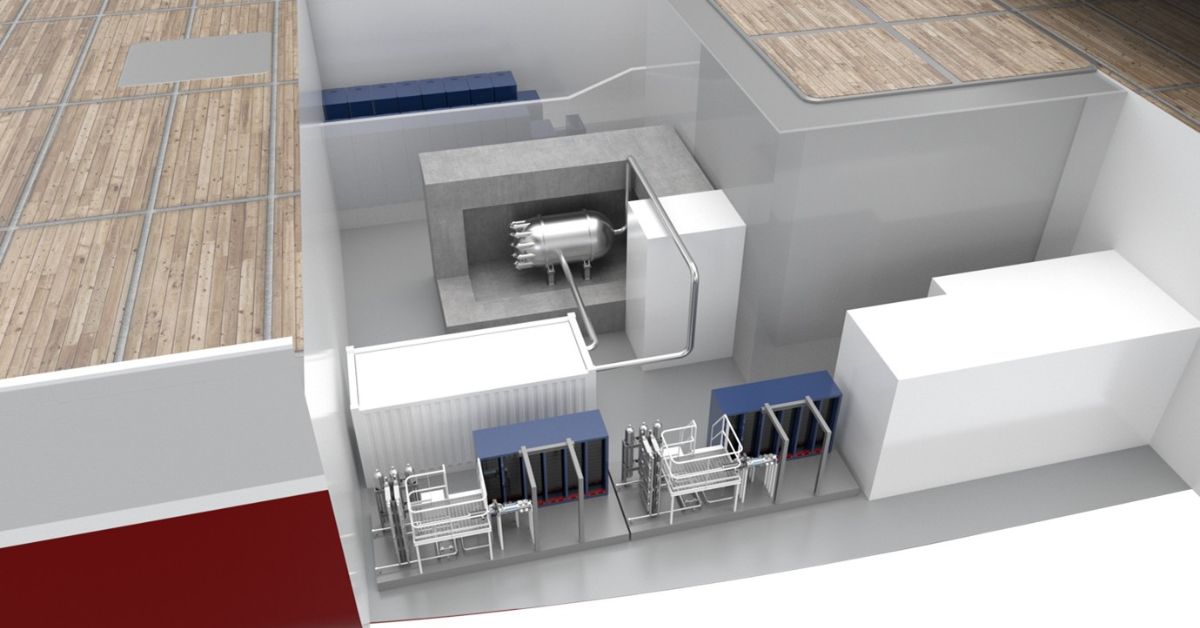
The NuProShip II project (Nuclear Propulsion in Merchant Shipping) has reached an important milestone with the completion of a detailed concept study examining how nuclear reactors could be used to power commercial dynamic positioning (DP) vessels.
Norwegian ship designer and builder VARD, part of the Fincantieri group, has delivered one of the project’s core contributions: a concept design for a nuclear-powered offshore construction vessel based on an existing VARD platform. The study looks at the integration of a helium gas-cooled nuclear reactor as the vessel’s main power source and assesses the implications for layout, safety systems and operational performance.
Focus on feasibility and system integration
The design work was led by Vard Design and carried out in close cooperation with DNV, Emerald Nuclear, Vard Electro, offshore vessel owner Island Offshore, and project lead Norwegian University of Science and Technology (NTNU).
According to the study, nuclear-powered DP vessels are technically achievable when based on validated assumptions and available supplier data. The proposed power architecture meets DP2 redundancy requirements and could be adapted to DP3 standards, which are typically applied to operations with more demanding safety and uptime requirements.
Beyond propulsion: energy management and safety
In addition to reactor integration, the project also examined alternative approaches to onboard energy management. These include the use of supercritical CO₂ turbines and thermal battery systems, which could help balance loads and reduce reliance on large conventional electrical battery systems.
Radiological safety and risk management were also central to the study. NuProShip II sets out initial principles for how nuclear systems could be handled in a civilian maritime context, while acknowledging that wider deployment would require updated regulations, operational experience, and public acceptance.
Industry input
Henrik Burvang, Research & Innovation Manager at Vard Design AS and responsible for NuProShip II at VARD, said:
“We are proud to contribute to the future of maritime innovation. NuProShip II demonstrates that nuclear-powered vessels are not just a vision, but a technically feasible solution. Our work lays the foundation for safer, more efficient, and environmentally responsible shipping. We hope this project brings real value to the continued development of maritime nuclear technology. It is also particularly valuable to have a professional ship owner and operator like Island Offshore in the project, proving that ship owners are focusing on this technology going forward.”
Regulatory and societal considerations
The project recognises that nuclear propulsion for commercial vessels is not without challenges. Key issues include the need for a modern regulatory framework tailored to civilian nuclear shipping, as well as the importance of transparency, environmental stewardship and public confidence. Addressing these aspects is seen as essential alongside technical development.
Funding and next phase
NuProShip II is a two-year research project funded by the Research Council of Norway. The project will conclude in 2026, after which further work will continue under SFI SAINT (Sustainable Applied and Industrialized Nuclear Technology), a new research-based innovation centre led by NTNU.
SFI SAINT has secured NOK 96 million in public funding, with industry partners—including VARD—contributing around NOK 200 million in kind. The centre is scheduled to operate for eight years from January 2026 and will focus on advancing nuclear technology for maritime and industrial applications.
Recent Posts
Technology
Econowind launches 30m VentoFoil 5-series for deepsea vessels
EV
Boreal orders 20 electric hydrofoil ferries from Candela for Norway operations
Ferries & Cruises
MEYER WERFT unveils battery-electric cruise ship concept ‘Vision’ at Seatrade Cruise Global