
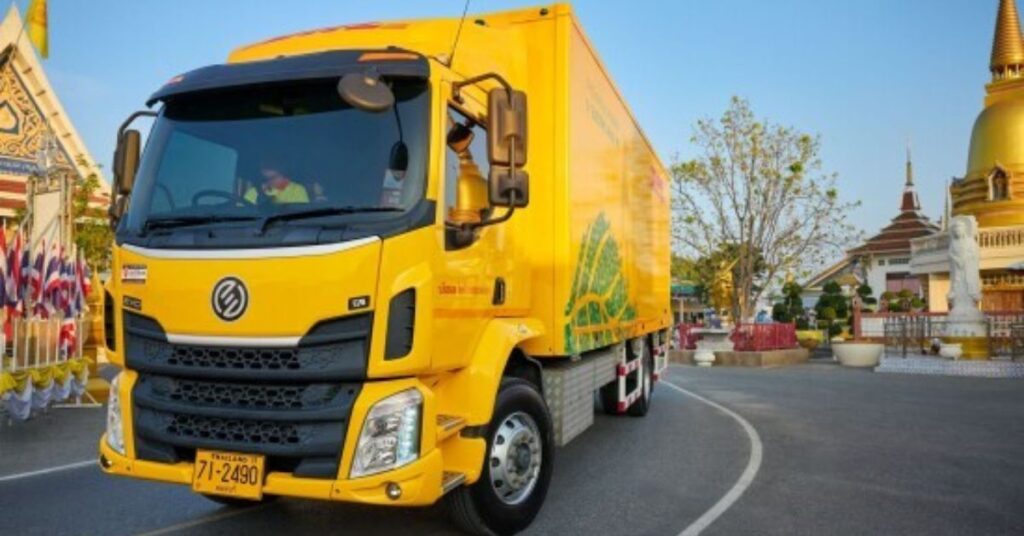
DHL Group has added new sustainability milestones across its Asia Pacific operations, spanning aviation, road transport and logistics infrastructure, as it steps up efforts to reduce emissions and meet growing demand for lower-carbon supply chain solutions in the region.
During 2025, the group advanced multiple initiatives under its decarbonisation roadmap, including new sustainable aviation fuel (SAF) supply agreements, an expanded electric vehicle (EV) fleet and the launch of carbon-neutral logistics facilities.
SAF agreements signed across key Asian hubs
In air freight, DHL continued to scale its use of sustainable aviation fuel, targeting 30% SAF usage by 2030. DHL Express signed SAF supply agreements in 2025 with Cathay, Cosmo Energy and Neste, covering close to 20 million litres of fuel.
The SAF volumes are earmarked for DHL Express flights departing from Narita, Incheon and Singapore. The company said it remains among the largest SAF users in the global logistics sector.
SAF uptake has also increased through DHL’s GoGreen Plus service, which allows customers to reduce Scope 3 emissions via a book-and-claim mechanism. In Asia Pacific, more than 153,000 customers used the service in 2025 for international air shipments.
Ken Lee, CEO, Asia Pacific, DHL Express, said:
“Sustainability isn’t just a slogan for us. We lead with action – whereas others follow – to reduce the greenhouse gas emissions from our operations. Together with the right partners, we are setting a benchmark for the logistics industry. We are determined to extend our efforts and scale solutions that can make a real impact for our customers and reduce our impact to the planet.”
Marine biofuel collaboration in ocean freight
In ocean transport, DHL Global Forwarding entered into a global partnership with CMA CGM to purchase 8,800 metric tonnes of UCOME second-generation biofuel.
The companies estimate the initiative could reduce approximately 25,000 metric tonnes of greenhouse gas emissions on a well-to-wake basis, supporting lower-carbon container shipping.
Niki Frank, CEO, Asia Pacific, DHL Global Forwarding, said:
“Our role goes beyond moving goods. We enable global trade to become more sustainable. Customers are increasingly asking for solutions that could help them decarbonize entire supply chains. With our global reach and expertise across air, ocean and road freight, DHL is uniquely positioned to deliver those ambitions through innovation and collaboration.”
Electric and hydrogen vehicles rolled out on land
On road transport, DHL continued to electrify and diversify its fleet. DHL Supply Chain deployed hydrogen-powered trucks in Japan for long-haul operations, while in Thailand it supported retailer Boots with a fully electric distribution fleet serving more than 250 stores.
In the Philippines, DHL Summit Solutions introduced 23 electric vehicles and 22 electric prime movers. DHL Express also added more than 100 electric vehicles across the Philippines, South Korea and China during the year, bringing its last-mile EV fleet in the region to over 1,400 units.
Across all divisions, DHL Group now operates more than 1,800 electric vehicles in Asia Pacific, aligned with its goal of electrifying two-thirds of its last-mile fleet by 2030.
Carbon-neutral logistics facilities added
DHL also expanded its low-carbon infrastructure footprint. In Thailand, DHL Supply Chain opened what it described as its first fully renewable-energy-powered warehouse globally. The facility operates on on-site solar generation, supported by a 4.2 MWp photovoltaic system and battery storage, eliminating reliance on fossil-fuel-based grid power.
Additional DHL Express service centres were launched in Thailand and the Philippines, designed to reduce energy consumption through efficiency measures and building design.
Javier Bilbao, CEO, Asia Pacific, DHL Supply Chain, said:
“When it comes to sustainability, we don’t wait for mandates – we act now to set new industry standards. Our carbon-neutral buildings and EV fleet developments reflect a long-term vision to reimagine logistics infrastructure for a low-carbon world. By investing early and decisively, we are shaping the future of sustainable and resilient supply chains for our customers and the industry.”
Net-zero ambition
DHL Group has set a target to achieve net-zero greenhouse gas emissions by 2050. The company said its Asia Pacific initiatives are intended both to support customer decarbonisation strategies and to signal long-term demand for lower-emission transport and logistics solutions across aviation, shipping and road freight.
Recent Posts
HYBRID
GRSE Signs ₹1,032-Crore ONGC Contract for Four Hybrid Offshore Supply Vessels
EV
Energy In Motion Opens ₹500-Crore Electric Truck Plant in Pune
Fuels
Aegis Logistics Commissions 35,000-Tonne LPG Bottling Plant at JNPA