Korea’s maritime authorities, classification society Korean Register (KR), and leading domestic shipbuilders have launched an international effort to develop safety and marine discharge standards for ammonia effluent generated by ammonia-fueled ships, addressing a regulatory gap as the industry prepares for wider adoption of zero-carbon fuels.
Ammonia is increasingly being considered as a next-generation marine fuel as the shipping sector works toward the International Maritime Organization’s 2050 net-zero target. While interim guidelines exist for the use of ammonia as fuel, there are currently no dedicated international standards governing the treatment and discharge of ammonia-containing effluent produced during vessel operations.
According to industry participants, effluent from ammonia-fueled ships differs from conventional aqueous ammonia in both physical and chemical properties, creating uncertainty for ship design, onboard systems, operational procedures, and environmental compliance.
To address this issue, Korean Register, working with Korea’s Ministry of Oceans and Fisheries, five major Korean shipbuilders—HD Hyundai Heavy Industries, HD Korea Shipbuilding & Offshore Engineering, HD Hyundai Samho, Samsung Heavy Industries and Hanwha Ocean—and the Korea Testing & Research Institute have established an international working group focused on ammonia effluent safety management and discharge criteria.
The initiative follows a proposal submitted by Korea to the IMO Sub-Committee on Carriage of Cargoes and Containers (CCC) in 2024, which called for the development of specific safety standards for ammonia effluent. The proposal received approval at the 83rd session of the IMO Marine Environment Protection Committee (MEPC) in April 2025.
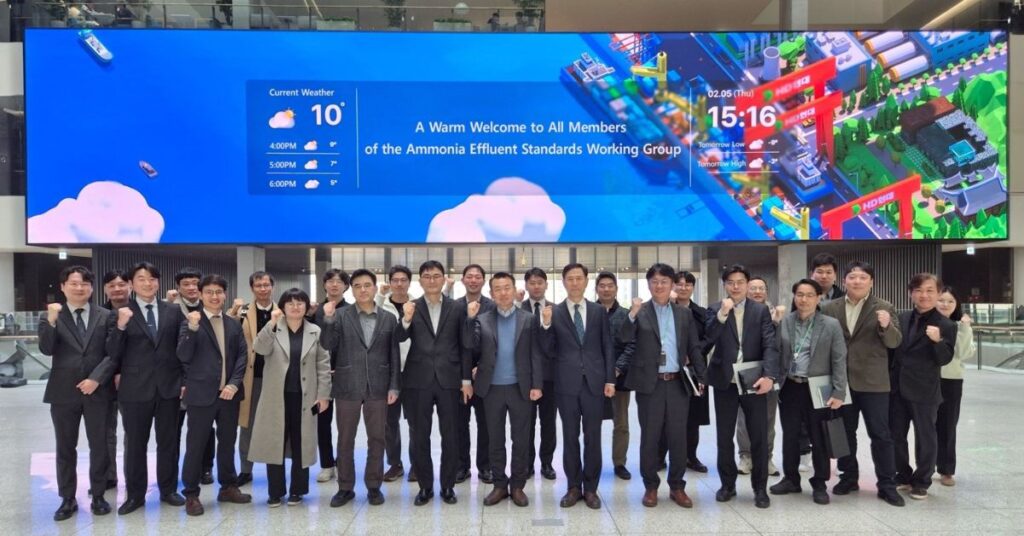
The working group met on 5 February at the HD Hyundai Global R&D Center to begin preparations for its 2026 work programme. Over 2026 and 2027, the group plans to submit draft international standards to the IMO Sub-Committee on Pollution Prevention and Response (PPR), with the aim of establishing globally applicable guidelines.
At the upcoming 13th session of the IMO PPR, scheduled for later this month, the Korean government delegation is expected to highlight the need for ammonia effluent management standards and propose the creation of a dedicated expert group for technical discussions. KR is contributing technical data to the process, including environmental impact assessments to support the definition of safe discharge limits.
KR Executive Vice President KIM Kyungbok said:
“This year’s IMO meetings mark the beginning of substantive international discussions on ammonia effluent safety standards. Drawing on KR’s technical and regulatory expertise, we will play a leading role alongside the Korean government and industry to ensure that proven domestic technical standards are effectively incorporated into international rulemaking.”
Recent Posts
Marine
82% of Maritime Professionals Say Current Training Falls Short of Operational Needs, Study Finds
Ammonia
Maersk Tankers Ammonia Retrofit Project Advances Towards EU Support
Policy
EU Maritime Innovation Projects Advance in €3.4-Billion Funding Selection