

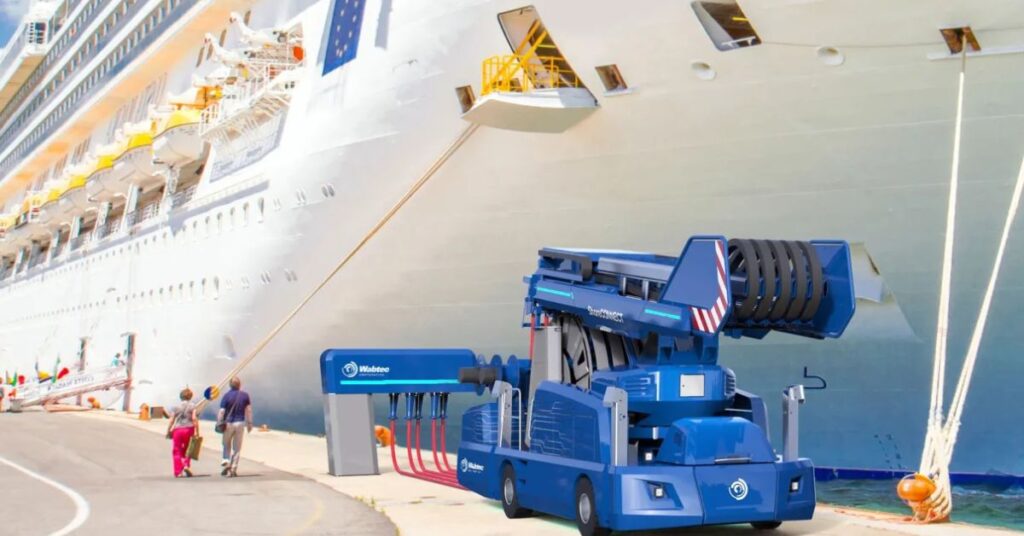
Ports worldwide are increasing investment in shore power and vessel charging infrastructure as regulatory pressure and decarbonisation targets reshape maritime operations. Wabtec is positioning its shore-to-ship power transfer systems as part of this transition, supporting cruise ships, container vessels and electric ferries with onshore charging solutions.
Maritime transport accounts for around 80% of global trade by volume, and ports are increasingly integrating grid-based power infrastructure to reduce emissions from vessels at berth. International and regional environmental regulations, along with local sustainability commitments, are accelerating the shift toward electrified port operations.
According to Olivier Kompaore, Vice President of Charging and Power Transfer at Wabtec, port operators are adopting shore power systems not only for regulatory compliance but also to improve operational efficiency and reduce environmental impact.
“Yes, there is a ‘green wave’ in the maritime industry, but port operators aren’t adopting sustainable power solutions solely for regulatory reasons: they are realizing that cleaner ports make good business sense,” he said.
“Port operators don’t have the luxury of pursuing innovation for innovation’s sake. They have to be practical and are looking for solutions that are environmentally friendly and drivers of efficiency, safety, and reliability.”
Shore power for cruise and cargo vessels
Cruise ships and large commercial vessels typically rely on auxiliary diesel engines while at berth to power onboard systems such as lighting, HVAC and refrigeration. A large cruise vessel can consume tens of thousands of litres of fuel during a port stay, generating carbon dioxide, nitrogen oxides, sulphur oxides and particulate emissions.
Wabtec’s Onshore Power Supply (OPS) solution, marketed as ShoreCONNECT, enables vessels to connect directly to the local electricity grid while docked, allowing engines to be shut down. The system serves as the interface between port-side electrical infrastructure and onboard systems.
“The idea in itself is simple: how best to plug a port’s power source into the ship’s electrical ‘socket’ while at berth, but the optimal execution of that feat draws on decades of power-transfer skills,” said Kompaore.
The system includes a cable management mechanism with a mechanical arm designed to handle high-capacity cables, allowing connections to be made by a single crew member. Configurations include both stationary and mobile units, and the system compensates for tidal movement.
Jan Frieling, ShoreCONNECT engineering lead, said:
“Wabtec’s shore power solutions come with an advanced mechanical arm that handles the heavy cables with great dexterity, enabling one port-side crew member to make the connection, whereas it used to take four.”
Ports including Barcelona, Bremerhaven, Naples, Nassau and Venice have adopted shore power systems. In Rostock, Germany, Wabtec has installed what it describes as Europe’s largest shore power plant, capable of supplying up to 20 MVA to two cruise ships simultaneously.
Automated fast charging for ferries
Electrification is also advancing in short-sea and ferry operations, where vessels operate on tight turnaround schedules. For these applications, rapid charging is essential.
Wabtec’s FerryCHARGER system is designed for high-power automated charging of electric ferries, enabling energy transfer during short docking windows. The system uses automated detection and connection technology, initiating charging within seconds of docking and disconnecting once charging is complete.
Julian Elskamp, FerryCHARGER engineering lead, said:
“When the ferry approaches the terminal, the ferry charger receives a wi-fi signal that readies it for action. Then, as the ferry docks, our system automatically detects the socket, connects to it, and commences charging – all in 10 seconds or less.”
The system has been deployed in ferry networks including Casco Bay Lines in Maine and is being supplied to Washington State Ferries for its hybrid-electric vessels. Ferry electrification projects in Nordic countries and Canada have also incorporated similar charging technologies.
Electrification reshaping port infrastructure
As ammonia, methanol and electrification pathways evolve in parallel, shore power and high-capacity charging infrastructure are becoming integral components of port modernisation strategies.
Kompaore said:
“No two ports are alike. That’s where our long history as a trusted solution provider helps us. We have an extensive track record of power-transfer innovation and versatility that is second to none in this space. Whatever the challenge, our port customers know we are on this journey with them and safe passage lies ahead.” Industry observers note that shore power deployment is expected to accelerate in the coming years as ports seek to reduce local emissions, improve air quality and align with global decarbonisation targets.
Recent Posts
Fuels
Lloyd’s Register and MARIC unveil tri-fuel-ready tanker concept designed to navigate fuel uncertainty
Ammonia Power & Propulsion
Fraunhofer IMM develops system solution for ammonia propulsion in inland shipping
Ports & Harbours
V.O. Chidambaranar Port identified as potential green shipping corridor node on India-Europe route