

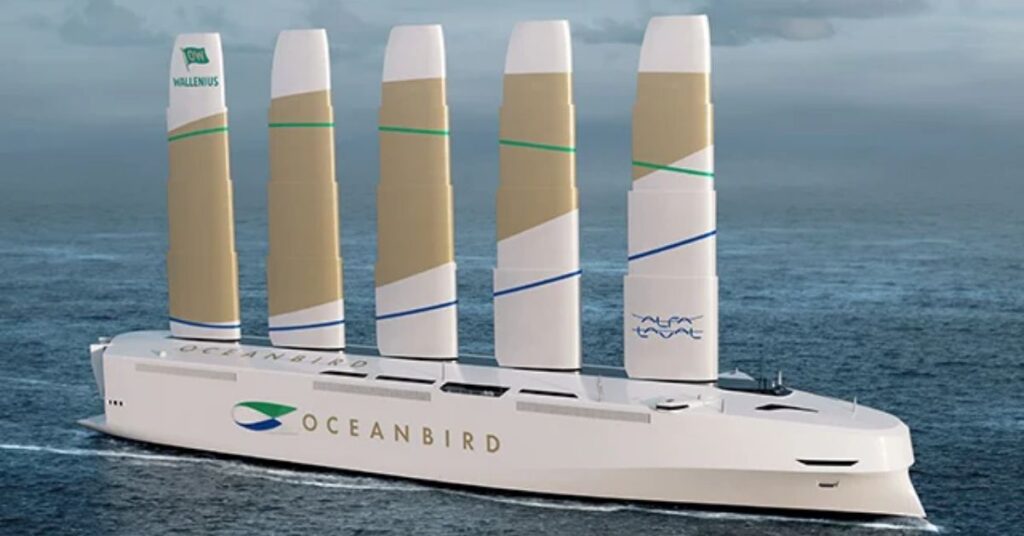
Alfa Laval and Wallenius Marine have announced plans to establish a 50/50 joint venture, AlfaWall Oceanbird, to develop and commercialise wind propulsion technology for ocean-going vessels.
The new entity will focus on the advancement of telescopic rigid wing sail systems designed to enable fully wind-powered propulsion. According to the companies, the technology has the potential to reduce emissions by up to 90% on certain large vessels, depending on operating profile and configuration.
The partners have previously collaborated on marine environmental solutions, including the PureBallast ballast water treatment system. Through AlfaWall Oceanbird, they aim to accelerate the deployment of wind-assisted propulsion as part of broader decarbonisation efforts in shipping.
“Wind has a key role to play in decarbonizing the marine industry,” said Peter Nielsen, Business Unit President, Alfa Laval Marine Division. “Together with Wallenius, we will harness this abundant natural force to meet both climate needs and those of maritime business.”
Per Tunell, COO of Wallenius Marine and future Managing Director of AlfaWall Oceanbird, said:
“Oceanbird wing sail technology will be not only an elegant solution, but also a powerful driver of positive change. Our vision at Wallenius is to lead the way towards truly sustainable shipping, and we are proud to partner with Alfa Laval in reaching it.”
Rigid wing sails for ocean-going vessels
The Oceanbird concept uses multiple rigid wing sails constructed from steel and composite materials. Unlike traditional fabric sails, the wings are designed to generate forward thrust rather than lift and can rotate 360 degrees to optimise wind capture.
The telescopic sails, which can extend up to 80 metres in height, are engineered to be lowered when passing under bridges, during adverse weather conditions or for maintenance. The system requires advanced control technology to manage sail positioning and interaction with the vessel’s hull.
“The wing sails are up to 80 metres tall and have a telescopic construction,” Nielsen said. “Besides adjusting to catch the wind, they can be lowered to pass under bridges, to handle harsh weather conditions or for maintenance. Because they will interact with the hull in a sophisticated way, they will also require intelligent control.”
The first planned application is a transatlantic car carrier capable of transporting around 7,000 vehicles. The vessel, approximately 200 metres in length, is designed to cross the Atlantic in about 12 days at an average speed of 10 knots. AlfaWall Oceanbird will concentrate on technical sailing systems, including the control platform governing wing sail operations.
Shipping decarbonisation context
Shipping accounts for roughly 2–3% of global greenhouse gas emissions and faces tightening climate targets under the International Maritime Organization framework. The IMO has set goals to reduce carbon intensity and total greenhouse gas emissions from international shipping, including a target of at least 50% reduction in total emissions by 2050 compared with 2008 levels.
Tunell said:
“We cannot wait until the end of the century to phase out fossil fuels. We must create realistic alternatives, including the infrastructure for delivering and supporting them. Wallenius is committed to wind propulsion, and we know from the experience with PureBallast that Alfa Laval can help us make it a global reality.”
Nielsen added:
“Alfa Laval has supported the marine industry’s evolution for more than 100 years, but today there is new urgency. Wallenius shares our environmental momentum and the determination to find immediate, workable solutions. Having once helped us explore our planet, wind can now help us rescue it.”
The joint venture marks a further step in the revival of wind-assisted propulsion technologies, as shipowners explore fuel alternatives and energy-efficiency measures to meet regulatory and commercial pressures.
Recent Posts
Fuels
Lloyd’s Register and MARIC unveil tri-fuel-ready tanker concept designed to navigate fuel uncertainty
Ammonia Power & Propulsion
Fraunhofer IMM develops system solution for ammonia propulsion in inland shipping
Ports & Harbours
V.O. Chidambaranar Port identified as potential green shipping corridor node on India-Europe route