
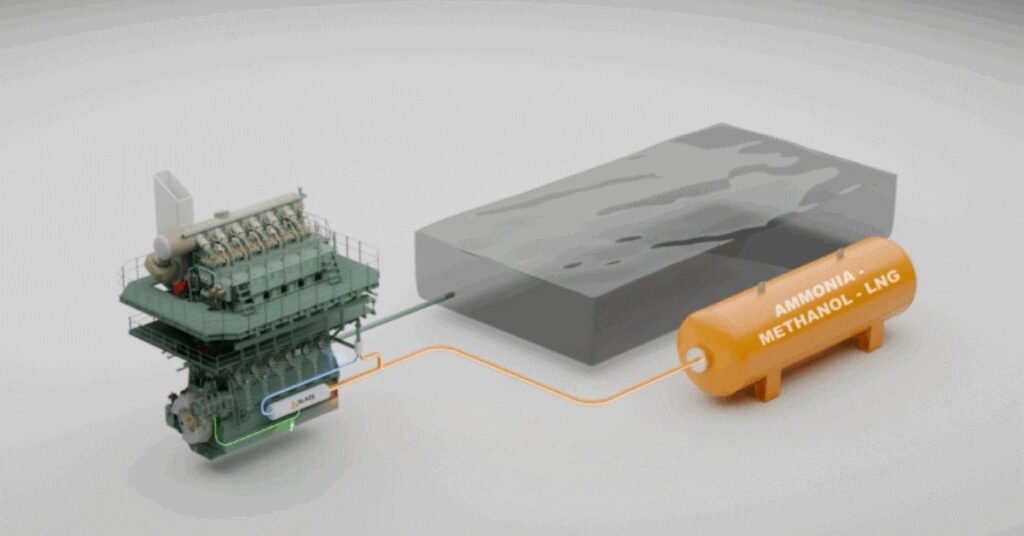
Lomarlabs and Blaze Energy have entered into a collaboration to pilot a compact onboard fuel reforming system designed to support multi-fuel engine operations in commercial shipping.
The project will focus on deploying Blaze Energy’s Flex-Fuel Reformer, a third-generation system engineered to convert fuels such as ammonia, methanol and liquefied natural gas (LNG) into hydrogen directly onboard vessels. The system is intended to enable engines and onboard power systems to operate using hydrogen blends, with the aim of reducing emissions while maintaining fuel flexibility.
The pilot system will be installed on a vessel operated by Lomar Shipping, with initial testing expected to focus on ammonia as the primary input fuel.
Onboard hydrogen conversion for fuel flexibility
According to the companies, the reforming technology allows ships to use a wider range of fuels by converting them into hydrogen at the point of use, potentially addressing challenges related to fuel availability, storage and engine compatibility.
The onboard pilot is expected to follow earlier land-based testing and engagement with classification societies, with installation planned for early next year. Testing under real operating conditions is intended to validate system performance and support future commercial deployment, including retrofits and newbuild applications.
Rok Sitar, CEO and Co-founder of Blaze Energy, said:
“This pilot marks a deliberate shift from proving technology to proving operability. By integrating Blaze Flex-fuel System with a trading vessel we are addressing one of the key bottlenecks in adopting alternative fuels: practical, safe, and flexible use in existing vessels.
Collaborating with an owner of this caliber allows us to validate the system under class-relevant conditions and build a credible pathway toward broader deployment with owners, OEMs and class societies.”
Supporting multi-fuel transition in shipping
The initiative reflects broader industry efforts to manage a transition that is expected to involve multiple fuel types rather than a single dominant solution. Technologies that allow operational flexibility are increasingly being explored as shipowners evaluate pathways to reduce emissions while maintaining commercial viability.
Stylianos Papageorgiou, Managing Director of Lomarlabs, said:
“The energy transition in shipping will be non-linear, and multi-fuel for longer than we may want or expect. Technologies that create optionality, rather than betting on a single outcome, will be strategically important. Blaze Energy works to bring to market a technology that delivers optionality to owners and resolves engineering bottlenecks. Our collaboration is about giving new technology the space and support it needs to iterate, learn, and prove itself in the real world.”
The pilot is expected to provide operational data to inform future development and potential scaling of onboard fuel reforming systems across different vessel types.
Recent Posts
HYBRID
GRSE Signs ₹1,032-Crore ONGC Contract for Four Hybrid Offshore Supply Vessels
EV
Energy In Motion Opens ₹500-Crore Electric Truck Plant in Pune
Fuels
Aegis Logistics Commissions 35,000-Tonne LPG Bottling Plant at JNPA