

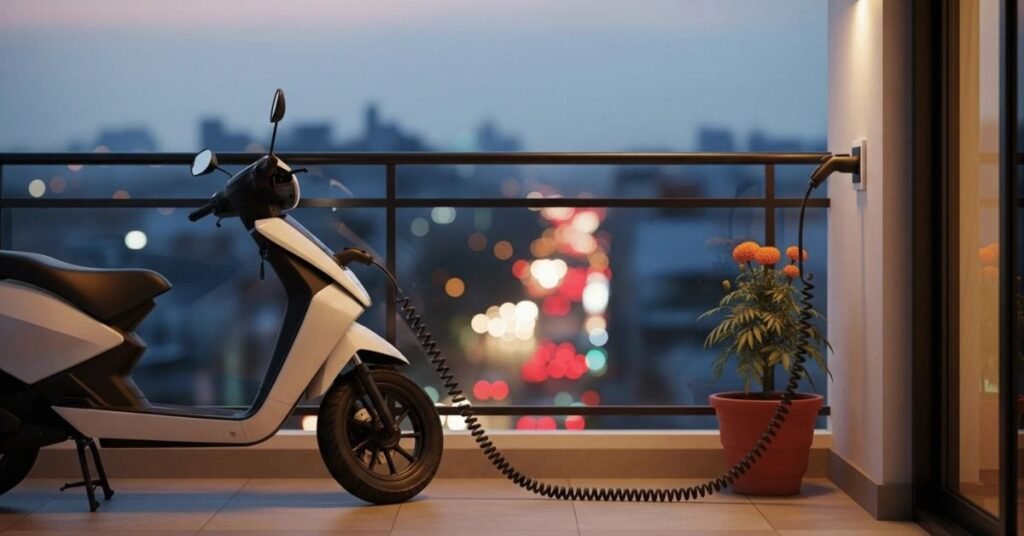
The Government of Delhi has released its draft Electric Vehicle (EV) Policy 2026–2030, proposing a phased transition away from internal combustion engine (ICE) vehicles, including a ban on new petrol-powered two-wheeler registrations from April 1, 2028.
The draft policy, currently open for public consultation, outlines a roadmap to accelerate EV adoption and reduce vehicular emissions in the national capital.
According to the proposal, two-wheelers account for nearly 67% of Delhi’s total vehicle population, making their electrification central to improving urban air quality. The policy document states, “Two-wheelers constitute approximately 67 per cent of the total vehicle stock in Delhi, making their rapid electrification critical for achieving meaningful reductions in vehicular emissions. Further, three-wheelers, commercial cars, and N1 category goods vehicles exhibit high daily utilisation and mileage, resulting in a disproportionate contribution to urban air pollution. Accordingly, prioritised electrification of these vehicle segments is essential to achieve sustained improvements in air quality in Delhi.”
Phase-out timeline for ICE vehicles
The draft sets out a phased approach for restricting new ICE vehicle registrations across key segments:
- Three-wheelers: Only electric models to be registered from January 1, 2027
- Two-wheelers: Only electric models to be registered from April 1, 2028
- Commercial operations: No new ICE vehicles permitted for aggregator-based services (including bike taxis and light goods vehicles up to 3.5 tonnes) from January 1, 2026
Existing BS6-compliant vehicles used in aggregator services will be required to transition to electric by December 31, 2026.
Incentives and financial support
To support adoption, the policy proposes a mix of subsidies, tax benefits, and scrappage incentives.
Electric two-wheelers priced up to ₹2.25 lakh would receive incentives linked to battery capacity, starting at ₹10,000 per kWh (capped at ₹30,000) in the first year, and tapering to ₹6,600 per kWh (₹20,000 cap) in the second year and ₹3,300 per kWh (₹10,000 cap) in the third year.
For other segments:
- Electric three-wheelers: ₹50,000 (Year 1), ₹40,000 (Year 2), ₹30,000 (Year 3)
- Electric light goods vehicles (N1 category): ₹1 lakh (Year 1), ₹75,000 (Year 2), ₹50,000 (Year 3)
Scrappage incentives are also proposed for replacing older vehicles:
- ₹10,000 for two-wheelers
- ₹25,000 for three-wheelers
- ₹1 lakh for four-wheelers
The draft includes 100% exemption on road tax and registration fees for electric vehicles priced up to ₹30 lakh, while EVs above this threshold would not qualify. Hybrid vehicles may receive up to 50% road tax relief until March 31, 2030.
Charging infrastructure and ecosystem development
The policy outlines measures to expand charging infrastructure across Delhi. Original equipment manufacturers (OEMs) would be required to install charging stations at dealerships, with minimum requirements for two/three-wheelers and four-wheelers.
Delhi Transco Limited has been designated as the nodal agency for planning and integrating charging and battery-swapping infrastructure. The draft also proposes a single-window clearance mechanism to streamline approvals.
In addition, the Delhi Pollution Control Committee will oversee battery lifecycle management, including Extended Producer Responsibility (EPR) compliance, recycling systems, and safe disposal. A battery traceability framework is also proposed to support reuse and second-life applications.
Funding and next steps
The policy proposes the creation of a dedicated EV Fund, to be financed through state allocations, central government schemes such as PM E-Drive, and other sources.
The draft policy is open for stakeholder feedback for 30 days before finalisation.
Recent Posts
Fuels
Lloyd’s Register and MARIC unveil tri-fuel-ready tanker concept designed to navigate fuel uncertainty
Ammonia Power & Propulsion
Fraunhofer IMM develops system solution for ammonia propulsion in inland shipping
Ports & Harbours
V.O. Chidambaranar Port identified as potential green shipping corridor node on India-Europe route