
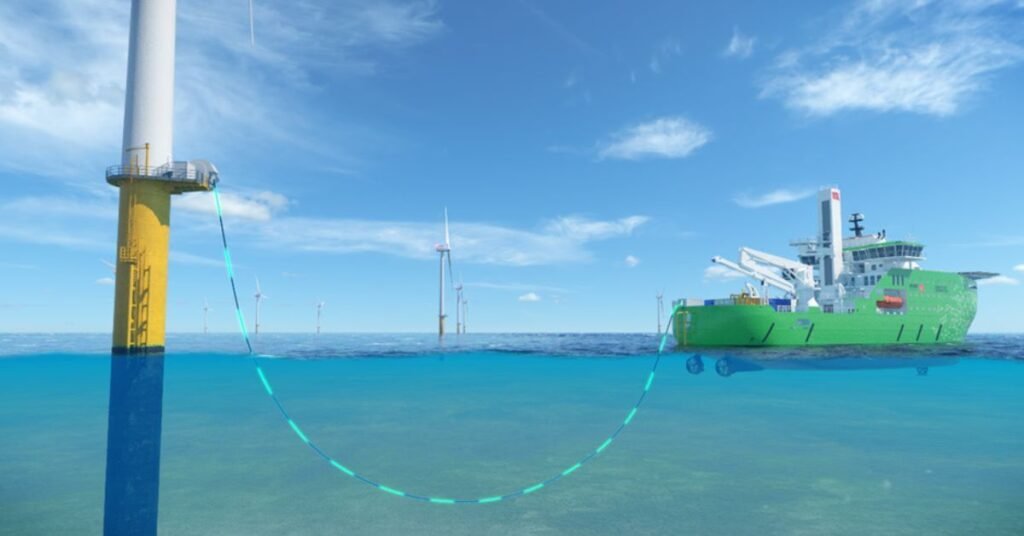
A coalition of offshore wind developers, vessel operators and maritime technology providers has called on governments and regulators to remove barriers preventing the wider deployment of offshore charging systems for vessels operating in the offshore wind sector.
In a newly published position paper, the coalition identified offshore charging — where vessels draw renewable electricity directly from offshore wind farms — as a potentially cost-effective pathway for reducing emissions from offshore support vessels.
Industry seeks faster deployment of offshore charging
The coalition stated that while offshore charging technology has advanced significantly in recent years, commercial deployment continues to face regulatory, operational and commercial obstacles rather than technical limitations.
According to the paper, electrification of offshore support vessels could help reduce emissions linked to offshore wind farm operations while supporting broader maritime decarbonisation goals.
The group outlined three main recommendations aimed at accelerating commercial adoption:
- Integrating offshore charging infrastructure into early-stage wind farm development plans
- Clarifying commercial and regulatory access to offshore electricity
- Developing a full-scale offshore charging demonstration project
Calls for clearer regulatory framework
Bibby Marine Newbuild Fleet Director Gavin Forward said:
“The technology to enable offshore charging is already here. The challenge now is creating the right regulatory and commercial environment to bring it into widespread use.”
He added:
“By addressing these barriers, we can unlock a practical and scalable route to decarbonising offshore wind operations.”
Maritime CleanTech Head of Innovation Øystein Huglen said:
“The maritime sector is integral to global electrification.”
He continued:
“An increasing number of fully electric maritime operations are becoming commercially viable. Offshore charging is clearly a game changer, especially for service vessels with access to locally-sourced electric energy from in windfarms.”
Offshore wind sector pushes for vessel decarbonisation
The coalition said the position paper reflects growing alignment across the offshore wind supply chain on the need to move beyond pilot projects and towards commercial-scale implementation.
Electrification of offshore support vessels is increasingly being explored as offshore wind activity expands and operators seek to reduce lifecycle emissions associated with wind farm construction, maintenance and servicing.
Industry stakeholders argue that enabling direct charging from offshore renewable energy infrastructure could improve operational efficiency while reducing dependence on conventional marine fuels.
Recent Posts
Events
Singapore International Bunkering Conference and Exhibition (SIBCON) 2026
Methanol
Deendayal Port to Begin Construction of 150 TPD e-Methanol Plant
Marine
NTNU to Acquire Kongsberg HUGIN 6000 for Ocean Technology Research