

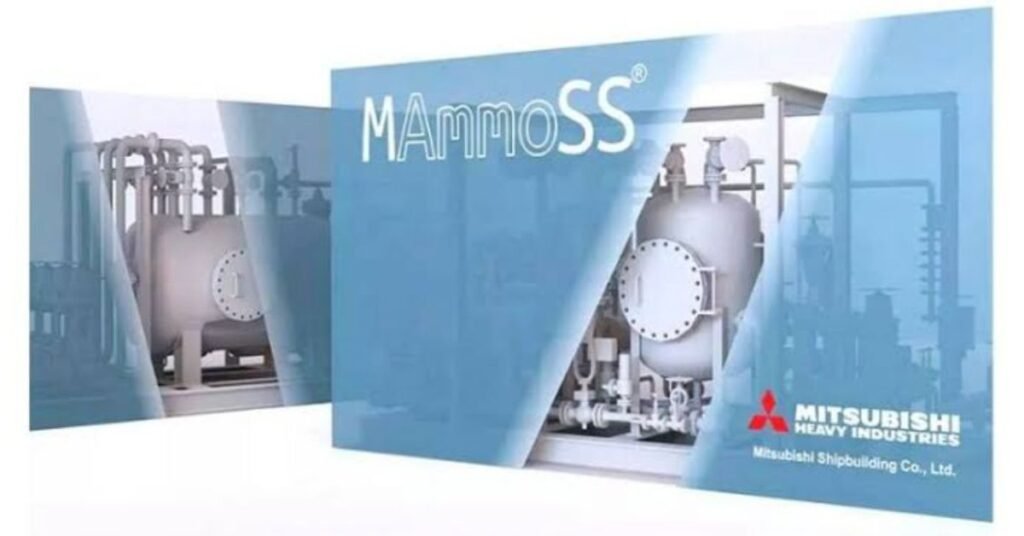
Mitsubishi Shipbuilding, part of the Mitsubishi Heavy Industries Group, has secured an order from Hitachi Zosen Marine Engine (HZME) for its MAmmoSS ammonia fuel handling system, a move that strengthens the supply chain for ammonia-fuelled vessel technology as the shipping industry pushes toward net-zero targets.
What will the system be used for?
HZME is a dual licensee of Everllence SE and WinGD, two major marine engine licensors. The MAmmoSS system will be designed and optimised for compatibility with both companies’ ammonia marine engines, and once delivered to HZME’s facility, it will be used to support shop tests for both engine types, a critical validation step before ammonia engines reach commercial deployment.
Why does ammonia fuel handling matter for decarbonisation?
The order lands against the backdrop of IMO’s ongoing efforts to cut greenhouse gas emissions from international shipping. The IMO’s Marine Environment Protection Committee adopted the 2023 IMO Strategy on Reduction of GHG Emissions from Ships at MEPC 80, targeting net-zero emissions from international shipping by 2050, while MEPC 83 approved mid-term measures to support that goal.
Ammonia has drawn significant industry attention as a next-generation marine fuel because it produces no CO2 when burned. But its toxicity as a fluid makes safe onboard handling technology essential, a requirement that is expected to drive growing demand for systems like MAmmoSS as more ammonia-fuelled vessels move from design to operation.
What’s next for Mitsubishi Shipbuilding?
The company said it will continue supplying safe and reliable products for ammonia-fuelled vessels to support anticipated market expansion, while working to enhance the system’s functionality to meet a broader range of customer requirements as adoption scales.
What does this signal for the ammonia fuel supply chain?
The order adds to a growing body of infrastructure investment supporting ammonia as a viable marine fuel pathway, coming as engine licensors, technology suppliers, and shipbuilders work in parallel to close the gap between ammonia’s theoretical emissions advantage and the practical safety systems needed to handle it onboard. As engine shop testing with dual-licensor compatibility moves forward, it marks a meaningful step toward commercial-scale ammonia propulsion becoming a realistic near-term option for shipowners.
Recent Posts
Power & Propulsion
Kongsberg Maritime to extend range of Elegance Pods for large cruise vessels
LNG
Qatari, UAE LNG cargoes transferred via ship-to-ship outside Strait of Hormuz
Power & Propulsion
Anemoi Marine Technologies to install first Rotor Sail on a Maersk container vessel