
Summary
Norway’s TMC Compressors has won a contract from China’s Jiangnan Shipyard to supply complete marine compressed air systems for two 90,000 cbm very large ammonia carriers being built for Eastern Pacific Shipping. The LPG dual-fuel vessels are part of EPS’s growing ammonia carrier fleet at Jiangnan, as owners prepare for rising seaborne ammonia trade.
Article
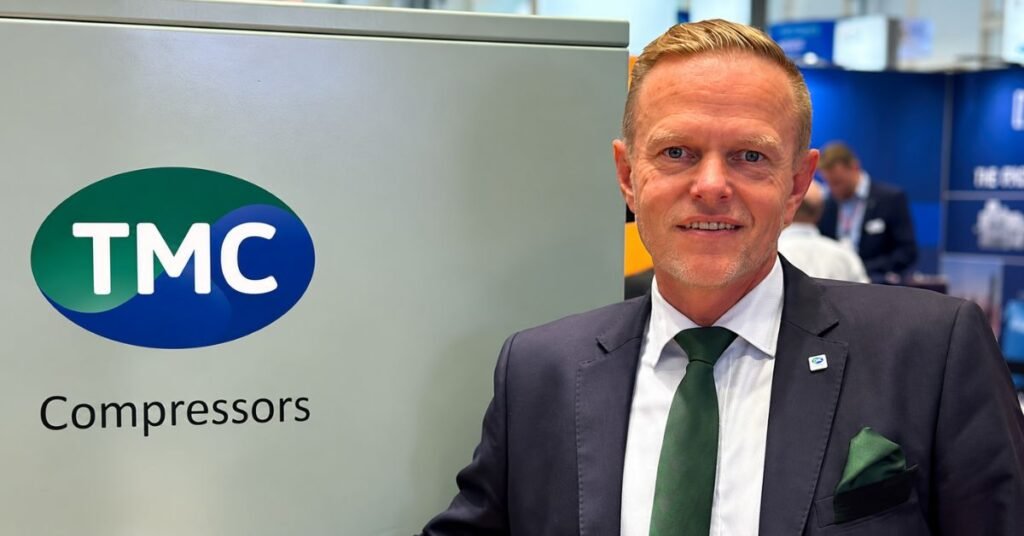
Oslo: TMC Compressors has been selected by Jiangnan Shipyard to deliver marine compressed air systems for two very large ammonia carriers (VLACs) under construction for Singapore-based Eastern Pacific Shipping (EPS), the Norwegian company announced on October 9, 2026.
Under the contract, TMC will supply a complete compressed air system for each vessel, including compressors for both control air and service air. The value of the contract has not been disclosed.
What will TMC supply?
The compressors are based on TMC’s own design, developed exclusively for marine and offshore applications. Control air powers the instruments and valves that regulate shipboard systems, while service air is used for general onboard tasks such as cleaning and maintenance.
Hans-Petter Tanum, TMC’s director of sales and business development, said the VLAC segment is becoming an attractive and strategically important market as demand grows for ammonia both as a fuel and an energy carrier. He said TMC was pleased to contribute to the operational reliability of the vessels. “Our technology development has always focused on energy efficiency,” he added.
What are the vessels?
Each VLAC will have a capacity of 90,000 cubic metres. EPS signed the shipbuilding contract for the pair with CSSC’s Jiangnan Shipyard on January 5, 2026. The vessels feature LPG dual-fuel propulsion and a next-generation low-resistance hull, which Jiangnan says will cut CO2 emissions by about 20% and SOx emissions by about 99% compared with conventional fuel systems.
The Old Panamax-size design has been optimised for cargo capacity and low resistance while staying within the limits of the Panama Canal’s original locks.
How large is EPS’s ammonia carrier programme?
The order extends a long-running partnership between EPS and Jiangnan. In 2023, EPS ordered six 93,000 cbm VLACs at the yard, then the largest of their kind globally, followed in 2024 by six 150,000 cbm ultra-large ethane carriers.
Deliveries from the earlier VLAC series are under way. EPS took delivery of Lilac Cove in September 2026, the second of the six 93,000 cbm vessels, after Ivy Cove in June. The ships can run on LPG or conventional fuel and can carry ammonia or LPG cargoes such as propane and butane.
Who is TMC Compressors?
Headquartered in Oslo, TMC has designed compressed air systems exclusively for marine and offshore use since 1996 and has delivered more than 25,000 compressors worldwide. In 2003, it introduced the TMC Smart Air compressor with variable speed technology for energy savings. Swedish industrial group Lifco acquired a majority stake in the company in 2016.
TMC operates service points in Asian shipbuilding hubs including China, Japan, South Korea and Singapore. It has previously supplied systems for large newbuilds, including four VLCCs at Hyundai Heavy Industries.
What does it mean for the gas carrier market?
The contract highlights how equipment suppliers are positioning for the expected growth in ammonia trade as the fuel gains ground in shipping decarbonisation. Ordering has been uneven, however. New LPG carrier contracts fell about 70% in 2025 compared with 2024, with orders for VLGCs, VLACs and VLECs particularly subdued, according to Veson Nautical.
DNV data shows the global LPG-capable fleet stands at 179 vessels, with 160 more due by 2030. Only 14 of the existing vessels can carry both LPG and ammonia, underlining why owners such as EPS are investing early in flexible VLAC tonnage.
FAQs
What has TMC Compressors been contracted to supply?
TMC will deliver complete marine compressed air systems, including control air and service air compressors, for two VLACs being built at Jiangnan Shipyard.
Who owns the vessels?
The two very large ammonia carriers are being built for Singapore-based Eastern Pacific Shipping.
What is the capacity of the VLACs?
Each vessel will carry 90,000 cubic metres and use LPG dual-fuel propulsion.
How much will the vessels cut emissions?
Jiangnan says the design reduces CO2 emissions by about 20% and SOx by about 99% compared with conventional fuel systems.
What other gas carriers has EPS ordered at Jiangnan?
EPS ordered six 93,000 cbm VLACs in 2023 and six 150,000 cbm ultra-large ethane carriers in 2024.
Recent Posts
Bunkering
SLNG third jetty to expand Singapore’s LNG bunker reload capacity
Biofuels
DSV Signs Up for CMA CGM ACT+ to Cut 12,000 Tonnes of CO2 with UCOME Biofuel
Technology
Sagar Defence and Lloyd’s Register Partner on Autonomous Maritime Systems Certification