
Summary
Singapore LNG Corporation has begun building a third jetty at its Jurong Island terminal, with completion scheduled for the second half of 2028. The development will expand facilities serving smaller LNG vessels and bunker suppliers, while newly obtained bio-LNG certification adds traceability across several terminal services.
Dedicated facilities for smaller vessels
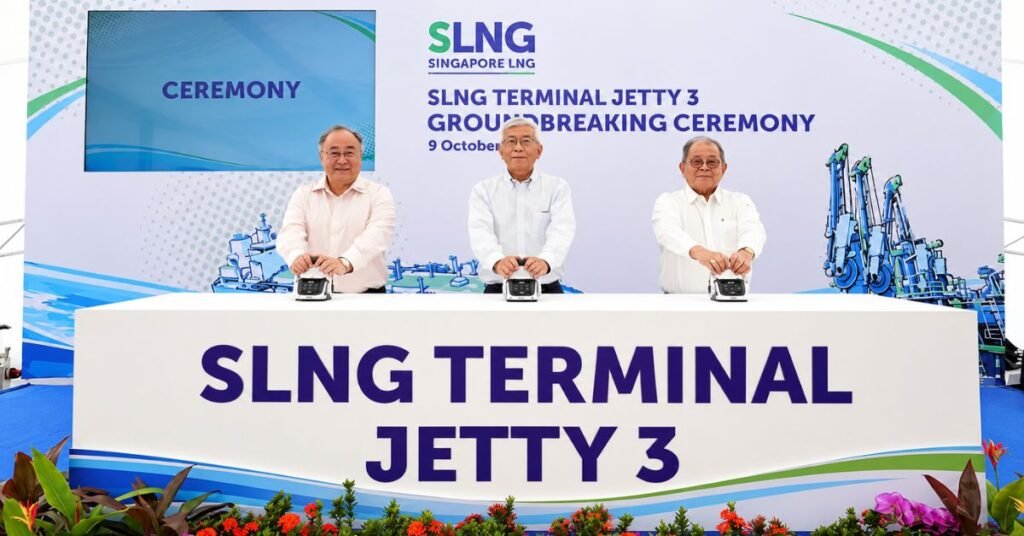
SLNG third jetty construction began on 9 October 2026, marking another expansion of Singapore’s infrastructure for supplying liquefied natural gas to the maritime market.
Jetty 3 will accommodate LNG carriers with capacities ranging from 5,800 to 80,000 cubic metres. It will be the terminal’s first jetty dedicated to small and mid-scale vessels, supporting bunker reloads, break-bulk movements and other smaller cargo operations.
When completed, the facility is expected to support approximately two million tonnes of annual LNG bunker reload demand. Combined with existing infrastructure, SLNG could potentially support up to three million tonnes annually, depending on market demand. These figures describe reload capability rather than confirmed future fuel sales.
Connecting large cargoes with smaller deliveries
The project expands the infrastructure connecting conventional LNG shipments with smaller deliveries. Through break-bulk services, terminal customers can bring in a conventional-sized cargo and reload it in smaller parcels onto bunker vessels or small and mid-scale carriers.
For bunker suppliers, this process provides a route for collecting LNG before delivering it to ships. For other customers, it supports onward distribution in quantities suited to smaller receiving markets. The commercial role of the terminal therefore extends beyond receiving imported gas for domestic use.
A dedicated berth for this vessel segment adds operational options within that distribution chain. Its significance lies in strengthening the link between bulk LNG supply, regional cargo movements and marine fuel delivery.
Building on earlier terminal developments
The groundbreaking follows SLNG’s award of the third jetty’s engineering, procurement and construction contract to Rotary Engineering on 8 April 2026.
Earlier investments established the terminal’s smaller-scale capabilities. SLNG completed its first small-scale LNG reload in June 2017, followed by its first jetty-to-jetty LNG transfer that December.
In February 2019, modifications to the secondary jetty enabled the terminal to reload vessels between 2,000 and 10,000 cubic metres. In March 2021, it completed the first cargo reload for FueLNG Bellina, Singapore’s first LNG bunkering vessel.
These milestones show that Jetty 3 builds on an established service, adding dedicated infrastructure after years of incremental development. The project is separate from Singapore’s second LNG terminal, whose onshore connecting infrastructure entered construction in March 2026 and whose floating storage and regasification unit reached keel-laying in May.
Earlier growth strengthens the market context
Singapore’s previous bunker sales figures illustrate the market underlying the expansion. LNG bunker sales increased from 110,000 tonnes in 2023 to 460,000 tonnes in 2024.
Overall alternative bunker fuel sales doubled to 1.34 million tonnes in 2024, while total bunker sales reached 54.92 million tonnes.
In December 2024, Singapore also launched an expression of interest for scalable sea-based LNG reloading solutions. That initiative sought to complement existing onshore storage and jetty capacity and support the supply of renewable methane-based marine fuels. The latest construction milestone adds another onshore component to this wider infrastructure development.
Road distribution is also being expanded
Alongside its marine facilities, SLNG began construction of a new LNG truck-loading facility in August 2025. That project was scheduled for completion in the fourth quarter of 2026.
The facility will have two loading bays and accommodate 40-foot trucks, compared with the existing facility’s provision for 20-foot trucks. It will be separated from main terminal operations and equipped with hard loading arms designed for single-operator use.
The truck-loading investment broadens distribution options on land, complementing the terminal’s vessel-based services. Its announced completion timetable remains distinct from Jetty 3’s 2028 target.
Bio-LNG certification accompanies expansion
SLNG has also obtained ISCC EU certification covering bio-LNG handling through storage, regasification and send-out, bunkering and trucking. Jetty 3 will be capable of handling bio-LNG.
The ISCC EU framework addresses sustainability and greenhouse gas criteria for eligible fuels. Certification provides a basis for verifying relevant credentials, making documented compliance an important element alongside the physical infrastructure needed to receive, store and distribute certified fuel.
FAQs
When will SLNG’s third jetty be completed?
Completion is scheduled for the second half of 2028.
What vessels will the new jetty accommodate?
It will serve LNG carriers ranging from 5,800 to 80,000 cubic metres.
How much LNG bunker reload demand will it support?
Approximately two million tonnes annually. Together with existing infrastructure, SLNG could potentially support three million tonnes, depending on demand.
What is LNG break-bulk?
It involves dividing a conventional-sized LNG cargo into smaller parcels for onward transport by bunker vessels or smaller carriers.
Will the third jetty handle bio-LNG?
Yes. The jetty will have bio-LNG handling capability, and SLNG’s terminal has obtained ISCC EU certification for relevant handling services.
Recent Posts
Bunkering
SLNG third jetty to expand Singapore’s LNG bunker reload capacity
Biofuels
DSV Signs Up for CMA CGM ACT+ to Cut 12,000 Tonnes of CO2 with UCOME Biofuel
Technology
Sagar Defence and Lloyd’s Register Partner on Autonomous Maritime Systems Certification