
Summary
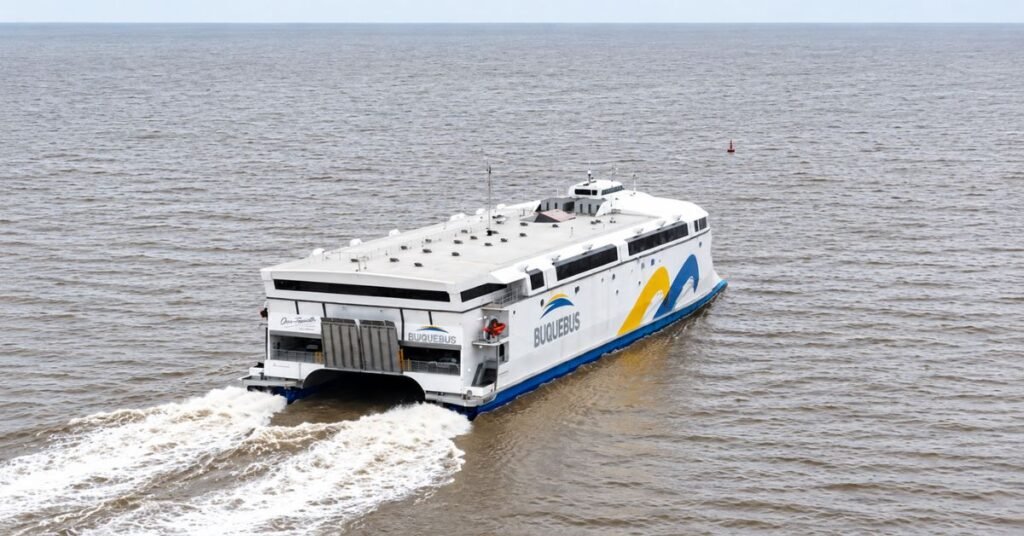
Buquebus has introduced China Zorrilla into commercial service between Argentina and Uruguay, bringing large-scale battery propulsion to international passenger and vehicle transport. Built by Incat Tasmania, the 130-metre ferry can accommodate 2,100 passengers and 225 vehicles, with more than 40 MWh of onboard energy storage powering its electric propulsion system.
Article
Commercial operations begin across the River Plate
The China Zorrilla electric ferry has completed its first commercial passenger crossing between Buenos Aires, Argentina, and Colonia, Uruguay, marking a significant operational milestone for battery-powered shipping.
Built at Incat Tasmania’s Hobart shipyard for Buquebus, the vessel entered service following an inauguration ceremony in Buenos Aires on 21 October 2026. Representatives of the shipbuilder, operator and maritime authorities from both countries attended.
Described by its builder as the world’s largest battery-electric ship, China Zorrilla moves the technology into a high-capacity international ferry application. Its entry into passenger service follows an extended programme of construction, electrical integration, testing and delivery.
Battery installation exceeds 40 MWh
Previously identified as Hull 096, the vessel incorporates an energy storage system exceeding 40 MWh, supplied through technology partners Corvus Energy and Wärtsilä.
In an October 2025 construction update, Incat detailed the installation of 5,016 battery units weighing approximately 250 tonnes. These were distributed across four purpose-designed battery rooms.
The batteries supply the ferry’s propulsion and onboard systems. Their installation illustrates the scale of the engineering required to move beyond smaller electric ferries into substantially larger passenger and vehicle vessels.
Battery-room design and electrical integration were therefore central elements of the shipbuilding programme, alongside the aluminium hull and passenger accommodation. The project brought together ship design, energy storage and propulsion equipment within a single vessel intended to complete its crossing entirely on battery power.
Eight waterjets form integrated propulsion package
Wärtsilä’s involvement dates back to an equipment order booked in July 2023 and announced the following month.
Its contracted scope included the energy management system, power conversion equipment, direct-current shore charging system, DC hub, eight electric motors and eight axial-flow WXJ1100 waterjets. Propulsion controls were also included.
The arrangement connects stored electrical energy with the motors that drive the waterjets. It also incorporates the equipment needed to manage power flows and replenish the batteries from shore.
At the project’s announcement, Wärtsilä highlighted low equipment weight, shallow draught and manoeuvrability as relevant characteristics of the waterjet configuration. These attributes were selected for the vessel’s particular operating requirements and high-speed catamaran design.
The equipment package demonstrates that ferry electrification involves coordinating the complete power and propulsion chain, including charging, control and energy management.
Delivery involved a separate heavy-lift operation
The ferry’s arrival in South America preceded its commercial debut.
The River Plate Administrative Commission confirmed that China Zorrilla reached Colonia del Sacramento on 13 September 2026. It had been transported aboard the heavy-lift vessel Black Marlin to the Nueva Palmira area in Uruguay.
Following authorisation coordinated with Argentine and Uruguayan maritime authorities, the ferry was discharged using a float-off procedure. Its subsequent passage to Colonia involved assistance from two tugboats.
That operation formed part of the vessel’s delivery and positioning process. The October passenger voyage represents the later transition into its intended transport role.
Commercial service becomes the next test
For Buquebus, the ferry combines substantial passenger accommodation with vehicle transport and approximately 2,300 square metres of duty-free retail space. Its commercial proposition therefore includes onboard spending alongside ticket and vehicle revenue.
For the wider ferry industry, the service provides an opportunity to observe battery propulsion under regular operating conditions at a larger scale. Relevant measures will include vessel availability, charging reliability, turnaround performance and energy consumption across different passenger loads and weather conditions.
The start of service establishes an operational milestone; longer-term performance will determine the strength of the business case for comparable routes.
Its immediate significance is clear: a large international passenger and vehicle ferry has moved from development and testing into commercial battery-electric operation, providing a practical reference for owners considering similar investments.
FAQs
Which route does China Zorrilla serve?
It operates between Buenos Aires in Argentina and Colonia in Uruguay, across the River Plate.
Who built the ferry?
Incat Tasmania built it at its Hobart shipyard for Buquebus.
What is its passenger and vehicle capacity?
The ferry can accommodate up to 2,100 passengers and 225 vehicles.
How is it powered?
Its battery system exceeds 40 MWh and supplies eight electrically driven waterjets.
Which companies supplied its main electrical systems?
Corvus Energy and Wärtsilä were the principal technology partners for energy storage and integrated electric propulsion.
Recent Posts
Ports & Harbours
VOC Port’s Tuticorin International Container Terminal Declared Green Terminal After Full Equipment Electrification
Hydrogen
India Could Become Leading Green Hydrogen Producer and Exporter, Says Gadkari
Fuels
Offshore Vessel Fuel Efficiency Offers Immediate Savings, Says Opsealog