
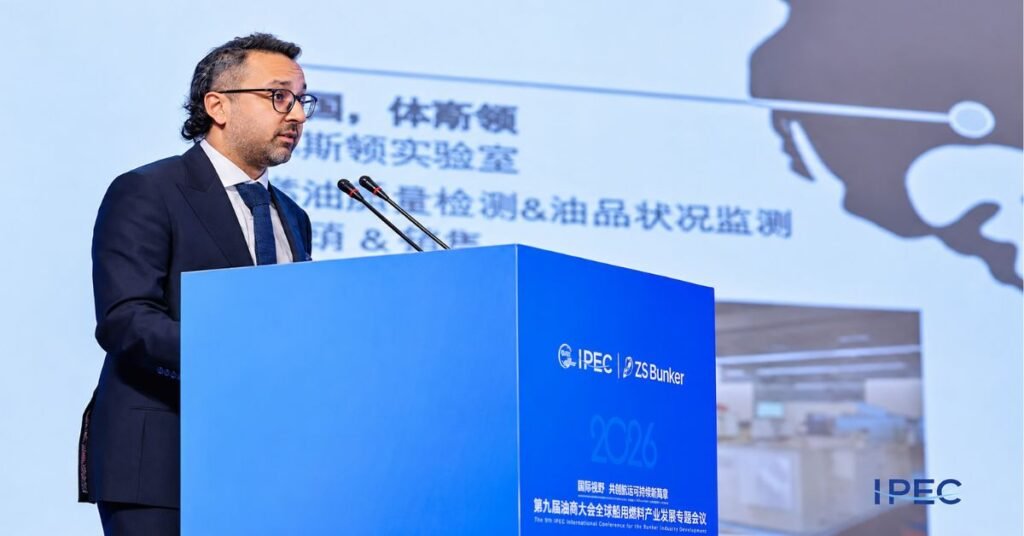
China’s Zhoushan recorded no bunker fuel alerts from testing company VPS in 2025, according to findings presented at the ninth Interregional Petroleum and Natural Gas Enterprises Conference (IPEC) on 22 October 2026. The assessment highlighted supply-chain controls as a factor supporting fuel quality at the Chinese bunkering hub.
Andrew Morton, VPS Managing Director for Asia, the Middle East and Africa, presented the findings during a session examining fuel quality at major bunkering ports. He attributed Chinese ports’ performance to disciplined refinery supply chains and closely controlled barge operations.
What did the assessment find about Zhoushan?
Morton identified control over refining and delivery logistics as important contributors to consistent bunker quality. His presentation contrasted this structure with more fragmented supply chains, where multiple trading and handling stages can increase exposure to contamination and quality disputes.
Chinese ports recorded no VPS bunker alerts during 2025, while Singapore accounted for 46% of the company’s alerts. Morton cautioned that Singapore’s share reflected the scale of its bunkering activity rather than uniquely poor operating practices.
The figures concern alerts issued by VPS. They should not be interpreted as a comprehensive certification of every fuel delivery at a port or as a volume-adjusted ranking of bunker suppliers.
Why are global bunker quality concerns rising?
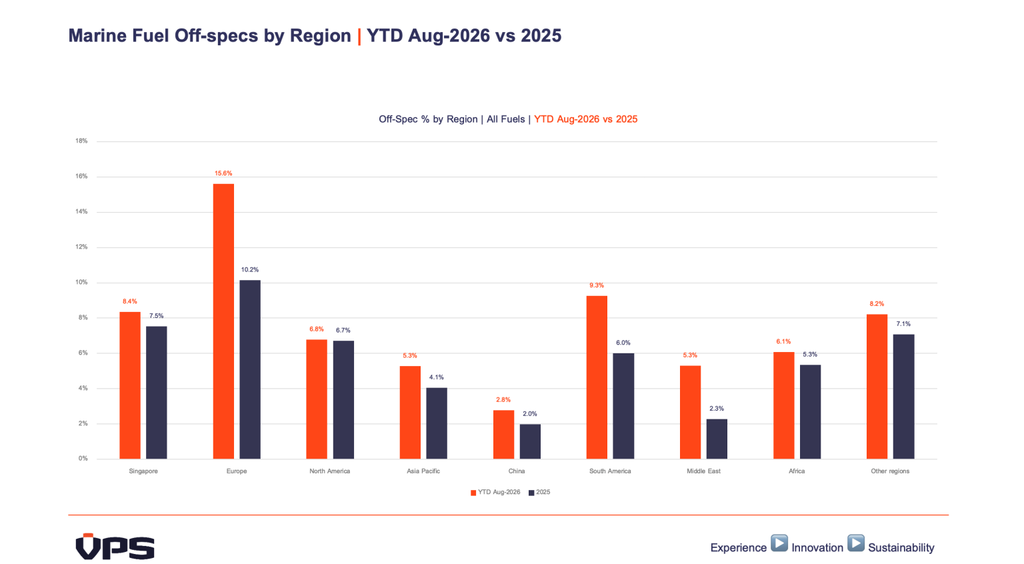
Separate VPS analysis covering January to July 2026 recorded 29 bunker alerts, compared with 37 during the whole of 2025. The seven-month total had already exceeded the number issued throughout 2024.
In that assessment, 8.87% of high-sulphur fuel oil (HSFO) samples and 9.88% of very-low-sulphur fuel oil (VLSFO) samples failed at least one ISO 8217 specification parameter. The corresponding rates were 9.03% for marine gas oil (MGO) and 19.58% for ultra-low-sulphur fuel oil. These percentages relate to samples tested by VPS, rather than all fuel supplied globally.
The distinction between alerts and individual test failures is significant. VPS reported no MGO bunker alerts during that period, despite recording off-specification MGO samples. The two measures therefore describe different aspects of fuel-quality risk.
What does ISO 8217 testing establish?
ISO 8217, the International Organization for Standardization’s marine fuel specification, provides a basis for assessing whether a delivered fuel meets agreed purchasing requirements.
VPS says its laboratory testing normally follows the customer’s contracted specification, with results evaluated by technical specialists who also provide handling advice. Its standard testing suite is normally completed within 24 hours of sample receipt.
However, the company cautions that compliance with ISO 8217, including the 2024 edition, does not address every potential operational risk. Additional testing can provide information beyond the standard specification and help determine how fuel should be managed before use.
How does fuel quality differ from sulphur compliance?
The International Maritime Organization’s global sulphur limit restricts fuel used outside designated emission control areas to 0.50% sulphur by mass, unless an approved equivalent compliance arrangement is used.
Sulphur compliance is only one part of fuel assurance. IMO guidance also addresses procurement, segregation, tank preparation and fuel changeover, alongside safe and efficient vessel operation.
For shipowners, Zhoushan’s reported alert record offers a useful procurement indicator. Individual delivery sampling, contractual specifications and appropriate laboratory testing remain necessary to establish whether a particular bunker stem is suitable for onboard use.
Recent Posts
Fuels
ONE Symphony Joins 14,000-TEU Fleet as ONE Expands Alternative-Fuel-Ready Newbuildings
Dual-Fuel
COSCO Ethylene Carrier Investment Adds LNG Dual-Fuel Capacity to Fleet Plans
Ammonia
MOL Ammonia-Fuelled Bulkers Named as 2027 Delivery Programme Advances