
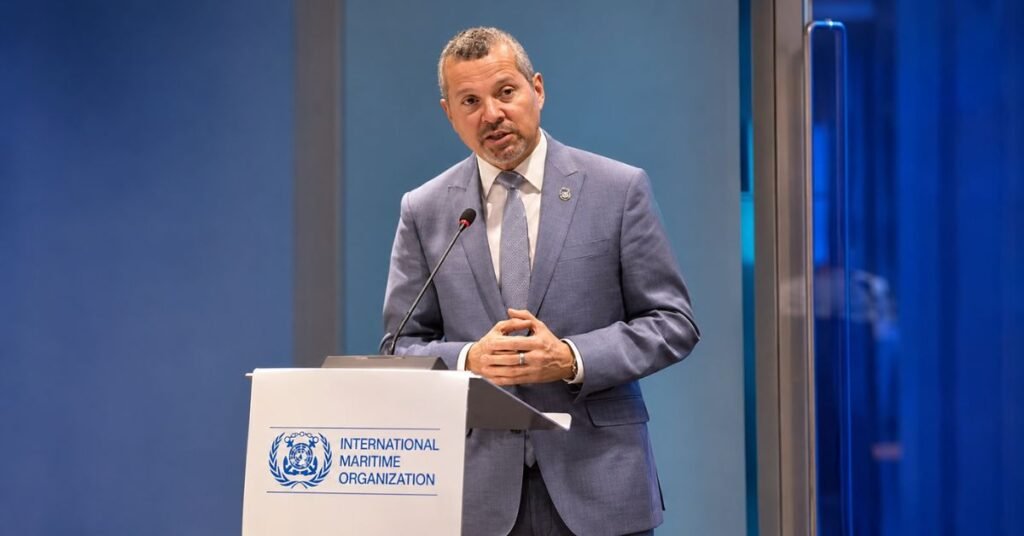
A coalition of 13 civil society organisations has written to International Maritime Organization (IMO) Secretary-General Arsenio Domínguez, seeking clarification on how liquefied natural gas (LNG) and other marine fuels will be assessed under the proposed IMO Net-Zero Framework.
The letter, dated 27 October 2026, followed remarks made by Domínguez at the Global Maritime Forum Annual Summit in Shanghai on 21 October. The organisations want assurances that fuel eligibility and incentives will be determined by member states through negotiations supported by independent scientific evidence.
What prompted the request for clarification?
At the Shanghai summit, Domínguez acknowledged that shipping’s transition to alternative fuels would take time. He also referred to newer engines designed to reduce methane slip and the potential contribution of biofuels.
Although he did not announce concessions for LNG, the coalition expressed concern that the remarks could be interpreted as anticipating favourable regulatory treatment. It asked him to confirm that his comments did not prejudge negotiations on LNG, biofuels or other energy sources.
The dispute concerns how fuels will be evaluated and rewarded under shipping’s emerging emissions rules, particularly whether their environmental performance is measured across the entire supply chain.
Why methane slip matters for LNG shipping
Methane slip occurs when methane, the main component of LNG, passes through an engine without being burned. Measuring these emissions is essential to assessing the fuel’s greenhouse gas performance.
The International Council on Clean Transportation (ICCT), in its January 2024 Fugitive and Unburned Methane Emissions from Ships study, recorded average methane slip of 6.4% across 18 vessels using low-pressure, dual-fuel four-stroke engines. This compared with the IMO assumption of 3.5% cited in the study.
The research combined measurements from drones, helicopters and onboard equipment. It recommended that regulators consider increasing the default methane-slip value for this engine category to at least 6%.
Onboard testing also found that methane slip was highest at the lowest engine loads. The findings concern a specific engine category and do not establish a uniform emissions rate for every LNG propulsion system.
How lifecycle assessment evaluates marine fuels
The IMO’s lifecycle assessment approach examines greenhouse gas emissions from fuel production through to consumption onboard a vessel, commonly described as well-to-wake accounting.
This combines upstream emissions, including production and delivery to the ship, with downstream emissions arising during onboard use. The approach enables assessment beyond carbon dioxide released at the exhaust.
The Marine Environment Protection Committee adopted revised lifecycle guidelines in March 2024. These cover fuel production pathways, emissions factors and sustainability information, providing a common basis for evaluating different marine energy options.
What commitments are the organisations seeking?
The coalition requested confirmation that member states retain authority over fuel treatment, supported by independent lifecycle assessments. It also sought equal access to technical briefings for delegations and continued alignment with the IMO’s climate objectives.
The organisations argued that methane-based fuels should qualify for rewards only where measured lifecycle emissions meet the relevant thresholds.
How the debate fits shipping’s climate targets
The IMO’s 2023 greenhouse gas strategy seeks net-zero emissions from international shipping by or around 2050. It includes indicative reductions in total annual emissions of at least 20%, striving for 30%, by 2030, and at least 70%, striving for 80%, by 2040, against 2008 levels.
Zero or near-zero greenhouse gas emission technologies, fuels and energy sources are intended to provide at least 5%, striving for 10%, of international shipping’s energy by 2030. These objectives provide the policy context for negotiations over marine fuel assessment and incentives.
Recent Posts
Fuels
ONE Symphony Joins 14,000-TEU Fleet as ONE Expands Alternative-Fuel-Ready Newbuildings
Dual-Fuel
COSCO Ethylene Carrier Investment Adds LNG Dual-Fuel Capacity to Fleet Plans
Ammonia
MOL Ammonia-Fuelled Bulkers Named as 2027 Delivery Programme Advances