
Summary
Japan Engine Corporation has secured orders for four ammonia-fuelled main engines for a Japanese car-carrier programme. The contracts connect its engine technology with a wider initiative covering vessel construction, operation and fuel supply. The ships are scheduled for completion in 2030, supported by a developing ammonia network in central Japan.
Four engines move programme towards commercial deployment
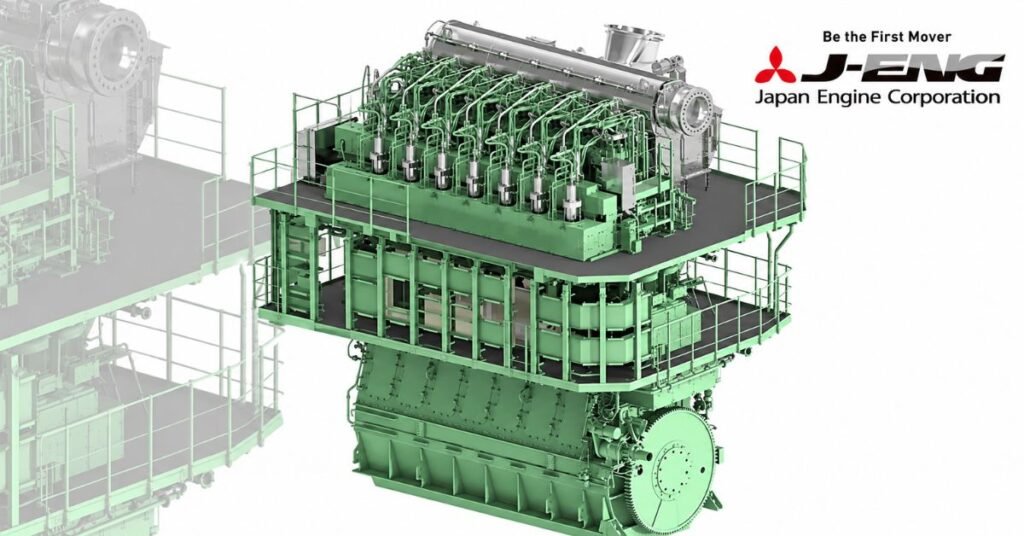
The J-ENG ammonia engine orders cover four 6UEC60LSJA-HPSCR units, each intended to power an ammonia-fuelled pure car and truck carrier.
Announced on 30 October, the orders place Japan Engine Corporation within a seven-company initiative unveiled three days earlier. The manufacturer will provide development, design, production and after-sales support for the engines.
J-ENG also said construction has begun on a factory intended to expand ammonia-engine manufacturing capacity. The facility is scheduled to begin operating in Japan’s fiscal year 2028, supported by a government programme promoting zero-emission ship construction.
For the manufacturer, the four-unit commitment extends ammonia propulsion beyond its initial engine project towards application across a series of commercial vessels.
Carriers will use a dedicated Japanese supply chain
The wider programme brings together Imabari Shipbuilding, Kawasaki Kisen Kaisha, Kyokuyo Shipyard, JERA, Shin Kurushima Dockyard, Nippon Yusen Kabushiki Kaisha and Nihon Shipyard.
“K” LINE and NYK plan to introduce two ammonia-fuelled car carriers each. Following scheduled completion in 2030, the ships are intended to transport finished vehicles for customers including Toyota Motor Corporation.
The project combines ship construction with development of an ammonia fuel-supply chain in Japan’s Chubu region. Shipbuilding participants will jointly contribute their design and construction expertise.
This coordinated approach addresses a practical challenge for alternative-fuel shipping: vessels and fuel infrastructure must become available on compatible schedules.
An engine order establishes propulsion demand, while commercial deployment also requires fuel procurement, storage, bunkering arrangements and operating procedures. Progress across these elements will determine whether the ships can use ammonia reliably in service.
Earlier engine programme provides the technical foundation
J-ENG’s ammonia-engine development began with approximately 1,000 hours of single-cylinder testing at Mitsubishi Heavy Industries’ research and development centre in Nagasaki between May 2023 and September 2024.
The company subsequently manufactured its first full-scale commercial ammonia engine, the seven-cylinder 7UEC50LSJA-HPSCR. Ammonia-fuel testing began in April 2025 and continued for approximately 700 hours over five months.
That programme examined combustion performance, reliability and safety, including systems for preventing and monitoring ammonia leaks.
The earlier engine has been installed on an ammonia-fuelled medium gas carrier being built for NYK by Japan Marine United. Experience from that development will inform the new engine series.
The two engine models represent different applications. Results achieved by the earlier unit provide development evidence, while performance of the newly ordered engines will need to be established through their own manufacture, testing and operation.
Combustion control remains central to emissions performance
Ammonia’s high ignition temperature and poor combustibility make stable engine operation technically demanding.
J-ENG reports that tests on its earlier engine, at full load and a 95% ammonia co-firing rate, recorded nitrous oxide emissions of approximately three parts per million. Under those conditions, the company reported greenhouse-gas emissions reductions exceeding 90%.
It also reported virtually zero unburned ammonia after selective catalytic reduction treatment, alongside thermal efficiency equivalent to or better than heavy-fuel-oil operation. These are manufacturer-reported results under specified test conditions.
For shipowners, the operating case will depend on maintaining combustion efficiency and controlling emissions across the conditions encountered during commercial voyages.
Indian supply agreement adds an international dimension
The Japanese programme also connects with emerging green-ammonia production in India.
On 27 October, JERA announced a binding Heads of Agreement with AM Green covering approximately 70,000 tonnes annually over five years. Supply is planned from Kakinada, Andhra Pradesh, through infrastructure near JERA’s Hekinan power station, primarily to support ammonia bunkering for car carriers.
Together, these developments connect engine manufacturing, vessel investment and prospective fuel imports. The immediate milestone is the four-engine order; the broader commercial task is synchronising those investments before the carriers begin operating.
FAQs
Which engines have been ordered?
Four 6UEC60LSJA-HPSCR ammonia-fuelled main engines.
What vessels will they power?
Four pure car and truck carriers under a Japanese industry programme.
Who will operate the ships?
“K” LINE and NYK plan to introduce two vessels each.
When are the ships scheduled for completion?
In 2030.
How does India feature in the fuel supply plans?
JERA’s agreement with AM Green envisages green-ammonia supply from Kakinada for a Japanese distribution network serving marine-fuel demand.
Recent Posts
Fuels
ONE Symphony Joins 14,000-TEU Fleet as ONE Expands Alternative-Fuel-Ready Newbuildings
Dual-Fuel
COSCO Ethylene Carrier Investment Adds LNG Dual-Fuel Capacity to Fleet Plans
Ammonia
MOL Ammonia-Fuelled Bulkers Named as 2027 Delivery Programme Advances