
Summary
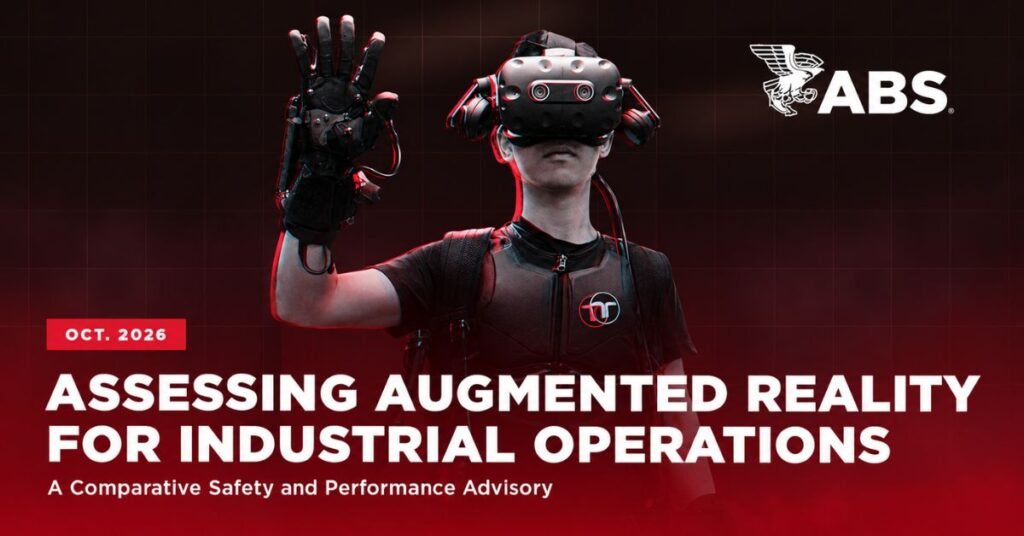
The American Bureau of Shipping (ABS) has published new guidance to help marine and offshore operators assess the safety and performance implications of augmented reality (AR) in industrial operations. The Advisory on Assessing Augmented Reality for Industrial Operations, developed with support from the ABS Laboratory for Ocean Innovation at Texas A&M University, provides a framework for comparing AR-enabled tasks with existing work practices across applications including inspection, maintenance, navigation, training and remote assistance.
Article
The American Bureau of Shipping (ABS) has released new guidance to help marine and offshore operators evaluate augmented reality (AR) applications for industrial operations, with a focus on assessing their impact on workplace safety, task performance and operational efficiency.
Published on 13 October 2026, the Advisory on Assessing Augmented Reality for Industrial Operations outlines a structured approach to determining whether AR technology can improve operational outcomes without introducing unacceptable safety risks. It is intended to support decisions on deploying AR across inspection, maintenance, navigation, training and remote assistance activities.
AR technology enables users to access digital information within their field of view while interacting with physical environments. Applications include displaying step-by-step work instructions for technicians, identifying inspection points and equipment tolerances, and highlighting hazard zones and restricted areas. However, the effectiveness of these applications depends on the task being performed, the user’s capabilities and the operating environment.
Patrick Ryan, ABS Senior Vice President and Chief Technology Officer, said: “Augmented reality could change how industrial work is performed, bringing expert guidance, operational data and digital workflows directly into the user’s field of view. To unlock that potential responsibly, industry needs a clear understanding of the safety and performance implications. This advisory provides the tools to evaluate the implications rigorously and consistently.”
Developed with support from the ABS Laboratory for Ocean Innovation at Texas A&M University, the advisory provides a methodology for comparing AR-assisted activities with established working methods. The framework considers both safety and performance, recognising that different tasks place varying demands on navigation, hand-eye coordination, memory and information processing.
The guidance also identifies potential limitations associated with AR deployment, including user distraction, visual occlusion and overreliance on information presented by digital systems. These factors can influence whether the technology delivers measurable benefits in real-world industrial settings.
As operators consider moving AR applications beyond pilot projects into routine operations, the ABS framework is intended to support consistent evaluation of their suitability for specific tasks and environments.
The advisory is available through the ABS website: https://www.eagle.org/augmentedreality.
FAQs
1. What has ABS published on augmented reality?
ABS has published the Advisory on Assessing Augmented Reality for Industrial Operations, providing a framework for evaluating the safety and performance of AR applications in industrial environments.
2. How can augmented reality be used in marine and offshore operations?
AR can provide technicians and other personnel with step-by-step instructions, equipment inspection markers, operational data and hazard-zone indicators. Potential applications include inspection, maintenance, navigation, training and remote assistance.
3. What risks of augmented reality does the ABS advisory identify?
The advisory highlights potential risks such as distraction, visual occlusion and overreliance on system outputs, which operators should consider when evaluating AR applications.
4. How does ABS recommend evaluating augmented reality?
The advisory outlines a structured methodology for comparing AR-enabled tasks with existing work practices, assessing safety and performance while accounting for the specific demands of each task and operating environment.
5. Who supported the development of the ABS augmented reality advisory?
The advisory was developed with support from the ABS Laboratory for Ocean Innovation at Texas A&M University.
6. Where can the ABS augmented reality advisory be accessed?
The advisory can be accessed through the ABS website at https://www.eagle.org/augmentedreality.
Recent Posts
Ammonia
Aegis Tristar acquisition to expand Indian group’s global energy logistics reach
Power & Propulsion
Everllence and MITSUI E&S Mark 100 Years of Two-Stroke Engine Partnership
Ammonia
NTPC Targets Japan, South Korea and Germany for Green Ammonia Exports from Andhra Pradesh Hub