
Summary
FuelEU Maritime pooling values fell by about $25/mtCO2e in a week to roughly $97/mtCO2e, according to bunker intelligence platform ENGINE, sharply reducing the compliance value of liquefied biomethane and B100. Combined with a surge in LBM prices, Rotterdam’s bio-LNG swung from a discount to a premium over fossil LNG, while Dutch renewable fuel tickets jumped.
Article
Singapore: A sharp fall in FuelEU pooling prices has weakened the economic case for biofuels and bio-LNG on European voyages, according to ENGINE’s weekly fuel switch snapshot for October 12, 2026.
ENGINE-assessed FuelEU Maritime pooling values fell by €21.70/mtCO2e ($25) over the week to €86.90/mtCO2e ($97). Some suppliers were still offering compliance surplus at €100-130/mtCO2e ($112-146), well above ENGINE’s assessment.
Why are pooling prices falling?
Under FuelEU Maritime, ships that beat the regulation’s greenhouse gas intensity limits can generate a compliance surplus and sell it to non-compliant ships through pooling. The value of that surplus is a key part of the economics of low-carbon fuels such as liquefied biomethane (LBM) and B100.
The latest drop continues a downtrend flagged by OceanScore in September. Sellers cut their prices after the summer as more of them, including new entrants, competed for buyers. Surplus supply has outpaced demand, and low costs of generating surplus have allowed aggressive pricing. OceanScore noted that some deals closed below the cost of generating the surplus, a sign of market overshooting.
How has this affected bio-LNG?
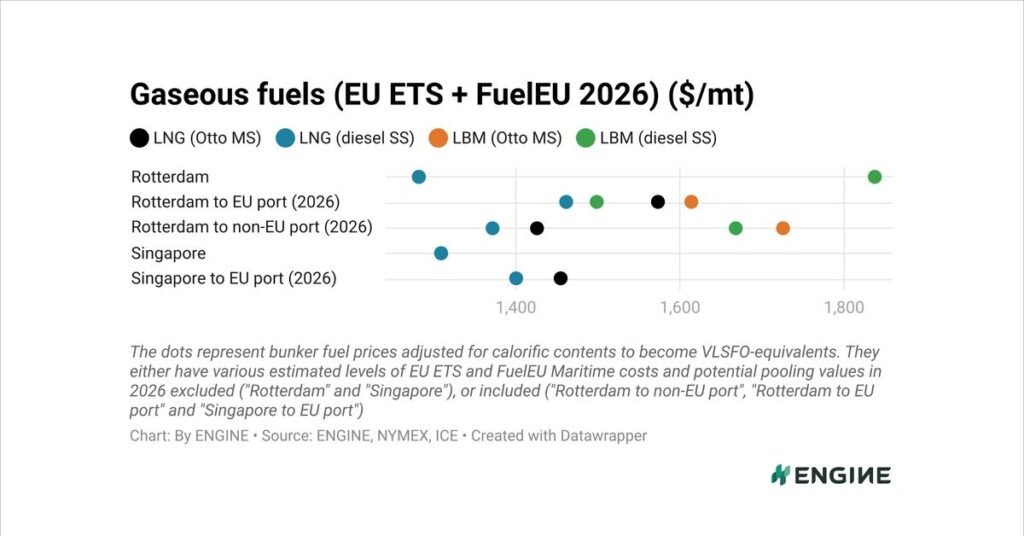
LBM’s potential pooling value for EU-EU voyages fell by $74-87/mt depending on engine type, while LBM prices in Rotterdam rose by $205-214/mt over the week. As a result, Rotterdam LBM swung from a $47-51/mt discount to fossil LNG to a $38-42/mt premium.
LBM’s premium over VLSFO widened to $400-516/mt, and its premium over B100 widened to $484-600/mt. By contrast, LNG’s potential pooling value for diesel slow-speed engines fell by just $13/mt.
What happened to B100?
B100’s potential pooling value for EU-EU voyages fell by $72/mt. In Rotterdam, B100 prices dropped by $45/mt, flipping from a $90/mt premium over HSFO to a $24/mt discount. Its discount to LSMGO widened to $720/mt, boosting demand. Availability is tight in the ARA region, with lead times of around five to seven days recommended.
In Singapore, a smaller $36/mt drop in B100’s pooling value for non-EU to EU voyages pushed B100 prices up by $30/mt, widening its premium over VLSFO to $337/mt.
What else moved?
Dutch ZRE A renewable fuel tickets surged by €67.50/mtCO2e ($75) to €240/mtCO2e ($269), following higher-priced trades and stronger bids late in the week, according to Prima Markets.
Rotterdam’s conventional fuels firmed, with VLSFO up $38/mt, HSFO up $69/mt and LSMGO up $102/mt. LNG prices rose by $115-125/mt. In Singapore, conventional fuel prices gained $1-54/mt, led by HSFO, while LNG rose $25-30/mt. Singapore’s VLSFO and HSFO markets are tight, with recommended lead times of 10 to 15 days.
Why does it matter?
The FuelEU pooling market is becoming a critical, and volatile, factor in fuel choice. When surplus is plentiful and cheap, shipowners may find it cheaper to buy compliance than to burn premium-priced biofuels or bio-LNG, slowing actual fuel switching. For suppliers of low-carbon fuels, falling pooling values reduce a revenue stream that helps offset higher fuel costs, a dynamic that could weigh on investment in alternative bunker supply.
FAQs
How much did FuelEU pooling prices fall?
ENGINE-assessed pooling values fell by €21.70/mtCO2e ($25) over the week to €86.90/mtCO2e ($97).
Why are FuelEU pooling prices declining?
Surplus supply has outpaced demand, more sellers have entered the market and low generation costs have allowed aggressive pricing, according to OceanScore.
How has bio-LNG pricing changed in Rotterdam?
Rotterdam LBM swung from a $47-51/mt discount to fossil LNG to a $38-42/mt premium.
What happened to Dutch ZRE A tickets?
They rose by €67.50/mtCO2e to €240/mtCO2e ($269) over the week.
Why does the pooling market matter for alternative fuels?
Cheap compliance surplus can make buying compliance more attractive than burning costlier biofuels or bio-LNG, slowing the shift to low-carbon fuels.
Recent Posts
Ammonia
Aegis Tristar acquisition to expand Indian group’s global energy logistics reach
Power & Propulsion
Everllence and MITSUI E&S Mark 100 Years of Two-Stroke Engine Partnership
Ammonia
NTPC Targets Japan, South Korea and Germany for Green Ammonia Exports from Andhra Pradesh Hub