
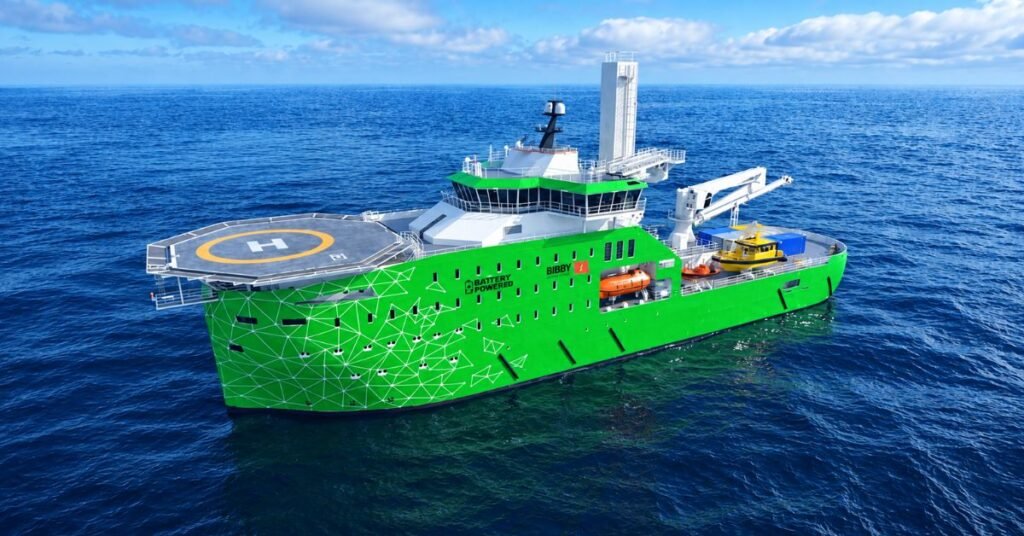
Bibby Marine is positioning its battery-first electric Commissioning Service Operation Vessel (eCSOV) as a solution for offshore wind operators seeking to reduce fuel consumption, operating costs and emissions before widespread offshore charging infrastructure becomes available.
The vessel is scheduled to launch in mid-2027 and has been designed to operate in a self-charging, battery-first mode. According to Bibby Marine, the configuration enables the vessel to use less fuel than a conventional CSOV while providing operational flexibility for offshore wind activities.
The company said battery-first vessels can deliver operating cost reductions without requiring immediate access to offshore charging infrastructure. Lower fuel consumption can reduce exposure to fuel-price volatility and carbon-related costs, while the vessel’s architecture provides a pathway towards greater electrification as offshore charging networks develop.
Battery-first system reduces generator fuel consumption
The eCSOV is not designed as a zero-fuel vessel. Its self-charging, battery-first system continues to use fuel, but allows the onboard generators to operate at a more consistent and efficient load rather than continuously adjusting to fluctuations in power demand.
Bibby Marine said this approach can reduce fuel consumption and associated emissions. Its dual-fuel eCSOV is expected to reduce genset fuel consumption by around 40% compared with conventional CSOVs.
Kevin Brown, Commercial Director, Bibby Marine, said one of the biggest misconceptions surrounding vessel electrification is that it only delivers value once offshore charging infrastructure is in place. He said that is simply not the case, and that Bibby Marine’s battery-first design has been developed to deliver meaningful commercial benefits from day one.
He said the industry doesn’t have to choose between today’s reality and tomorrow’s ambition, adding that battery-first vessels allow operators to begin reducing operating costs immediately, while ensuring they are ready to take advantage of offshore charging as the infrastructure develops, making the self-charging, battery-first eCSOV a practical vessel for the transition, commercially viable from day one, with a clear pathway to further savings.
eCSOV under construction in Spain
Bibby Marine’s first eCSOV is currently under construction at Armon Shipyard in Vigo, Spain. The project involves technology partners including Kongsberg, Corvus Energy and Stillstrom.
The vessel is expected to be commissioned in mid-2027.
The battery-first configuration is intended to bridge the current gap between vessel electrification and the availability of offshore charging infrastructure, allowing operators to begin reducing fuel use while retaining the option of greater electric operation as charging capacity expands.
Recent Posts
Biofuels
WinGD Ethanol-Fuelled Engine Completes First In-Service Voyage on Maersk Vessel
Power & Propulsion
Norsepower Rotor Sails Installed on Airbus Cargo Ship Spirit of Toulouse
EV
Estonia Electric Ferry to Combine Steerprop Propulsion with Battery Power