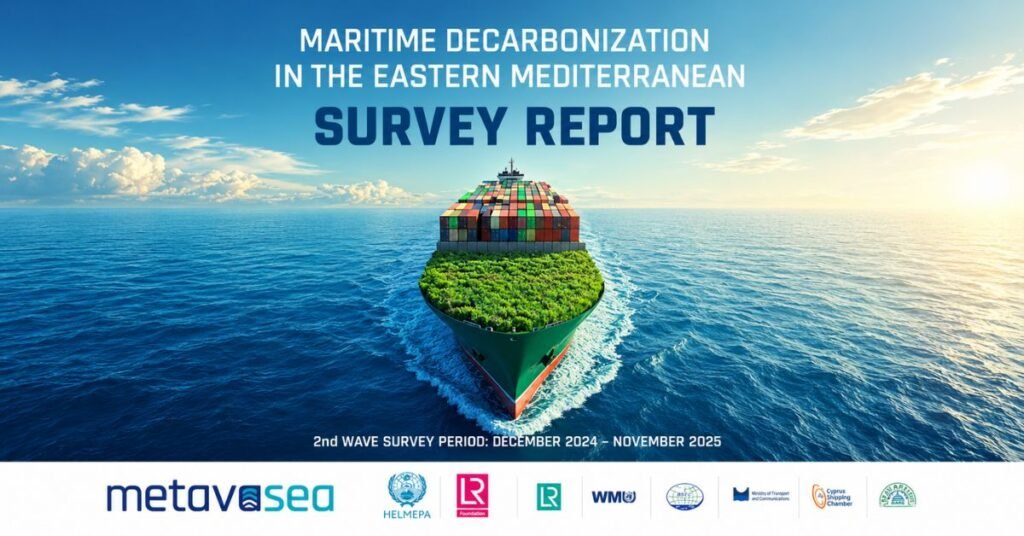
The latest findings from the METAVASEA survey indicate growing awareness and strategic alignment around maritime decarbonisation in the Eastern Mediterranean, while highlighting gaps in implementation capacity, workforce readiness and public understanding of shipping’s environmental impact.
The Wave 2 findings, released by the Hellenic Marine Environment Protection Association (HELMEPA), suggest that shipping companies are increasing their climate ambitions faster than the sector is developing the infrastructure, skills and workforce capacity required to implement them.
Data for the second wave were collected between December 2024 and November 2025, covering the period surrounding the initial adoption of the IMO Net-Zero Framework at the 83rd session of the International Maritime Organization’s Marine Environment Protection Committee (MEPC 83) in April 2025.
Crew fatigue remains a key safety concern
Seafarers continue to identify crew fatigue as their leading safety concern, highlighting the workforce and operational challenges facing the maritime sector alongside its decarbonisation objectives.
The survey also points to a continuing gap between public perceptions and the industry’s actual contribution to global greenhouse gas emissions.
The findings build on METAVASEA’s first-wave survey, conducted between June and November 2024. That survey found that members of the public estimated shipping’s contribution to total global GHG emissions at between 50% and 70%, compared with the actual figure of approximately 3%.
New survey examines maritime training
HELMEPA has also launched a related survey examining the role of training in the maritime industry’s transition.
Titled “Is Training an Investment or a Cost”, the spin-off survey was launched by HELMEPA Youth Ambassador Leader Anna Maria Angelopoulou under the academic supervision of Christopher Wiernicki, MIT NAVSEA Professor of the Practice in Mechanical Engineering.
The initiative focuses on the relationship between investment in training and the development of skills needed to support maritime decarbonisation.
METAVASEA focuses on people and skills
METAVASEA, which means “transition” in Greek, takes a people-centred approach to maritime decarbonisation in the Eastern Mediterranean.
The region has strategic importance for shipping because of its concentration of maritime activity, while also facing exposure to the effects of climate change. The project seeks to examine the human, infrastructure and skills requirements associated with the sector’s transition to lower-emission operations.
Launched in 2023, METAVASEA is a five-year initiative running through 2027. It is coordinated by HELMEPA with strategic and financial support from Lloyd’s Register Foundation.
The project brings together HELMEPA and its consortium partners to assess the infrastructure and workforce skills needed to support the Eastern Mediterranean’s maritime energy transition.
What does the METAVASEA Wave 2 survey show?
The Wave 2 findings point to three key areas requiring further attention: the capacity to implement decarbonisation strategies, workforce preparedness and public understanding of shipping’s environmental footprint.
While strategic commitment to maritime decarbonisation is increasing, the findings indicate that closing the gap between ambition and implementation will require continued attention to infrastructure, training, workforce conditions and stakeholder awareness.
Recent Posts
Biofuels
WinGD Ethanol-Fuelled Engine Completes First In-Service Voyage on Maersk Vessel
Power & Propulsion
Norsepower Rotor Sails Installed on Airbus Cargo Ship Spirit of Toulouse
EV
Estonia Electric Ferry to Combine Steerprop Propulsion with Battery Power