
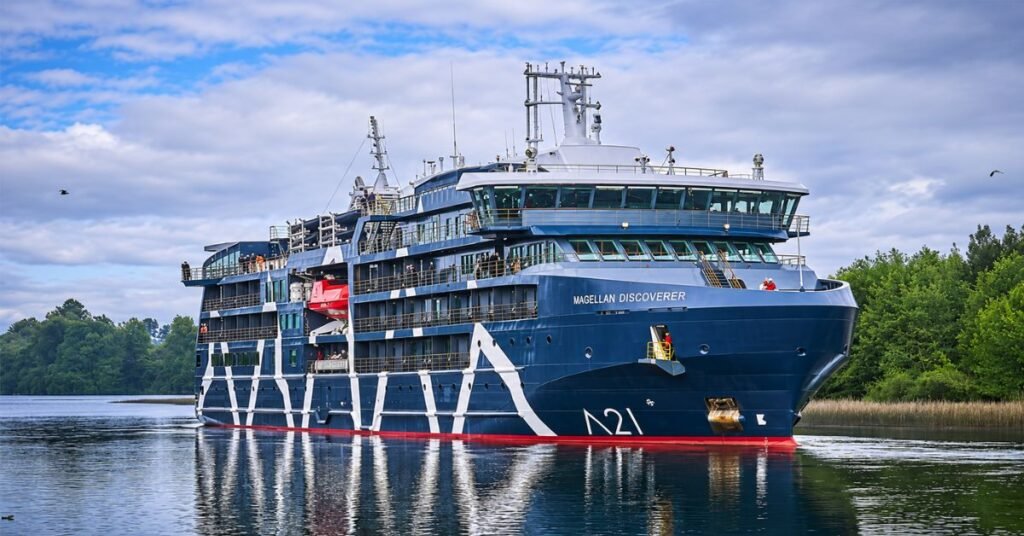
Antarctica21’s new hybrid-electric expedition ship, Magellan Discoverer, has made its first call at Arturo Prat Pier in Punta Arenas, Chile, ahead of its scheduled christening on 6 November 2026. Empresa Portuaria Austral, the port operator, confirmed the arrival on 4 November. The ship’s maiden passenger voyage is scheduled for 15 December and will take in southern Chile and Antarctica.
The port call follows nearly three years of construction at the Astilleros y Servicios Navales (ASENAV) shipyard in Valdivia. The Chilean yard designed and built the vessel for Antarctica21, returning to a partnership that produced the operator’s first purpose-built expedition ship, Magellan Explorer. The two vessels will operate alongside each other during the Antarctic season.
From the Valdivia shipyard to Punta Arenas
Magellan Discoverer completed an initial round of sea trials in early October. On 26 October, it left the Valdivia yard for Corral, on Chile’s Pacific coast, for final trials before handover. Antarctica21 took delivery on 30 October, completed the registration formalities and provisioned the ship for the passage south.
At Arturo Prat Pier, representatives of Empresa Portuaria Austral welcomed the vessel and presented a commemorative award to its captain. The christening in Punta Arenas is timed to coincide with Chile’s Antarctic Day on 6 November. The ceremony comes more than five weeks before the first scheduled passenger sailing.
How does the ship’s hybrid propulsion work?
The 94-metre Magellan Discoverer has a Polar Class 6 (PC6) ice rating. Its diesel-electric propulsion system combines MAN engines, ABB’s onboard direct-current power network and a Corvus Energy battery bank. ABB also supplied the Azipod electric propulsion units, while Fincantieri supplied the stabilisers. Antarctica21 coordinated the engineering work with the shipyard and equipment manufacturers.
For polar expeditions, the battery system offers a specific operational benefit. According to ABB, the crew can switch off the engines and draw on stored power for quiet operation in environmentally sensitive areas. The electrical network also allows the ship to integrate other power sources, including fuel cells, in a future refit. ABB identifies Magellan Discoverer as the first hybrid-electric polar cruise ship built in the Americas with Azipod propulsion.
How will Antarctica21 deploy Magellan Discoverer?
Passenger numbers will depend on the itinerary. Antarctica21 specifies a maximum of 76 guests on air-cruises and 96 on sea voyages. Under the air-cruise model, passengers fly over the Drake Passage to join the vessel in Antarctica. This allows the operator to use the ship for the expedition itself while guests avoid the open-water crossing from South America. The vessel can accommodate up to 67 crew.
Antarctica21 president Jaime Vásquez said demand for this fly-and-cruise format informed the decision to commission a second purpose-built ship. Working again with the Valdivia yard gave the operator another small expedition vessel under its own control. Beyond the December maiden voyage, the ship’s intended operating area includes the Antarctic Peninsula, South Georgia and the Falkland Islands.
Recent Posts
Technology
KONGSBERG introduces two sonar systems to expand underwater surveillance capabilities
EV
NITI Aayog and GIZ partner to accelerate electric truck adoption in India
Marine
New LR service targets cargo disruption when trade routes fail