
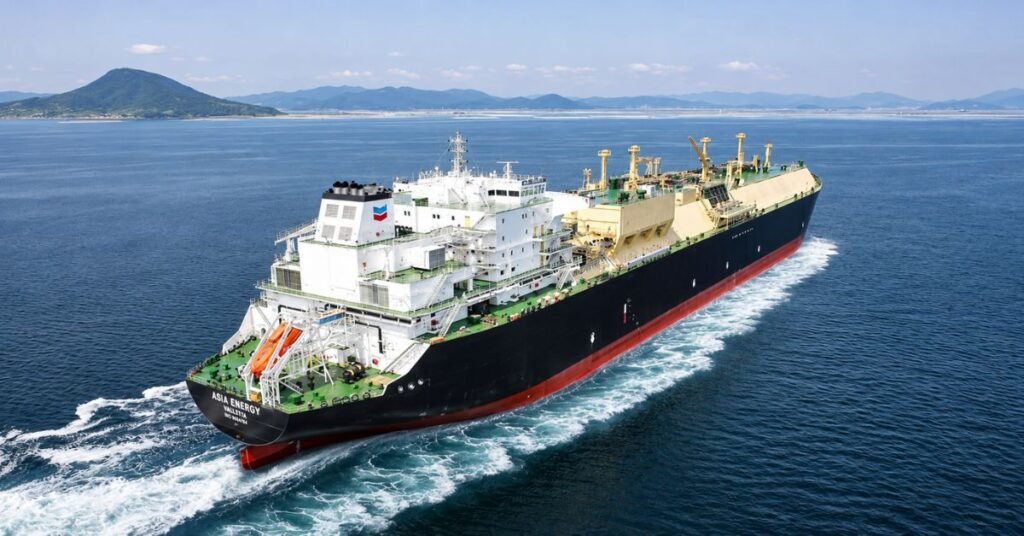
Wärtsilä has converted one engine on each of three liquefied natural gas (LNG) carriers operated by Chevron Transport Corporation to reduce the amount of unburned methane escaping through the exhaust. The work, announced on 3 November 2026, takes the partners halfway through a six-vessel retrofit programme. They plan to carry out the remaining three conversions over the rest of 2026 and into 2027.
The conversion changes how an existing Wärtsilä 50DF engine ignites its fuel. In gas mode, the original dual-fuel engine uses a small quantity of diesel to start combustion. The converted engine uses a spark instead. Wärtsilä estimates that methane escaping from the converted engine will amount to 1.1% of fuel use, averaged across a standard engine test cycle.
How does spark ignition reduce methane slip?
Methane slip occurs when some of the gas entering an engine passes through it without burning. That methane reaches the atmosphere through the exhaust. The amount matters because methane traps considerably more heat than carbon dioxide over a 100-year period, even though it remains in the atmosphere for a shorter time.
At the centre of the Wärtsilä retrofit is an electrically controlled valve in the pre-combustion chamber, where ignition starts. The valve and spark ignition system give the engine greater control over combustion. Wärtsilä says this allows more of the gas to burn and improves efficiency. The retrofit is available for existing 50DF engines installed on ships with diesel-electric propulsion, most of them LNG carriers.
Chevron Shipping and Wärtsilä announced the six-ship plan in September 2024 after two years of joint development. Wärtsilä booked orders for the first two vessels in the July–September quarter of that year. From the outset, the partners specified one engine per carrier, allowing them to apply the retrofit across several ships already in service.
What does the 1.1% methane figure measure?
Wärtsilä’s estimate expresses the methane expected to escape as a share of fuel used by the converted engine. It uses the International Maritime Organization’s E2 cycle, a standard method for assessing constant-speed propulsion engines, including those used in diesel-electric systems. The figure describes the expected level of slip after conversion. Calculating the reduction achieved in service would require a comparable figure for the engine before the retrofit.
The E2 calculation combines four engine settings. Operation at 75% of rated power accounts for half the weighted result. Full power accounts for 20%, while the 50% and 25% power settings each account for 15%. A carrier’s actual voyages can involve a different mix of engine loads. The amount of fuel each engine consumes on board would also matter when calculating methane emissions for the whole ship.
Why does methane slip matter for ship operators?
European Union rules have given operators a financial reason to quantify methane emissions. Ships covered by the EU’s maritime monitoring rules have had to report methane and nitrous oxide alongside carbon dioxide since 2024. From 2026, both gases also count towards obligations under the EU Emissions Trading System.
FuelEU Maritime takes a broader view, measuring the annual greenhouse gas intensity of energy used on board over the fuel’s lifecycle. The calculation includes emissions from fuel production and supply as well as methane released during combustion. The Chevron conversions address the part of that calculation an engine retrofit can directly influence: how much of the gas delivered to the engine leaves the exhaust unburned.
Recent Posts
Technology
KONGSBERG introduces two sonar systems to expand underwater surveillance capabilities
EV
NITI Aayog and GIZ partner to accelerate electric truck adoption in India
Marine
New LR service targets cargo disruption when trade routes fail