
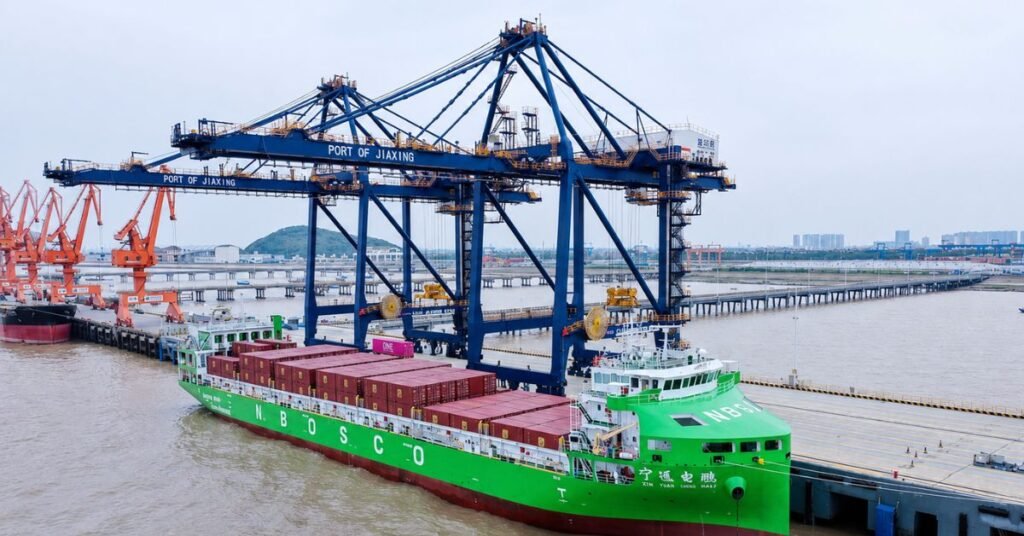
China has officially launched its first sea–river intermodal zero-carbon shipping route, marking a milestone in the country’s efforts to decarbonise inland and coastal freight transport. The new route entered service on 30 June with the maiden voyage of the fully electric container vessel Ningyuan Dianpeng from Jiaxing Port in Zhejiang Province to Ningbo-Zhoushan Port.
The new service combines inland waterway and coastal shipping using a fully battery-powered vessel, demonstrating the growing role of electric propulsion in China’s maritime logistics network.
Fully Electric Container Ship Powers New Green Corridor
The Ningyuan Dianpeng is a 10,000-tonne-class fully electric container vessel measuring 127.8 metres in length and 21.6 metres in width. The vessel has a cargo capacity of 742 twenty-foot equivalent units (TEU).
Propulsion is provided by 10 containerised battery units with a combined energy storage capacity of approximately 20,000 kilowatt-hours (20 MWh), enabling zero-emission operations along the sea–river transport corridor.
The deployment of the vessel marks the commercial launch of China’s first intermodal shipping route designed to operate without direct greenhouse gas emissions during navigation.
Supporting Maritime Decarbonisation
The new route forms part of China’s broader strategy to accelerate the adoption of low- and zero-emission technologies across its transport and logistics sectors.
Battery-electric vessels are increasingly being introduced for short-sea shipping and inland waterways, where predictable sailing distances and access to charging infrastructure make full electrification commercially viable.
By combining electric propulsion with sea–river intermodal operations, the project is expected to support lower emissions while advancing the development of sustainable freight transport networks.
The launch also reflects growing investment in battery-powered commercial vessels as ports and shipping operators seek alternatives to conventional marine fuels in support of decarbonisation goals.
Recent Posts
HYBRID
GRSE Signs ₹1,032-Crore ONGC Contract for Four Hybrid Offshore Supply Vessels
EV
Energy In Motion Opens ₹500-Crore Electric Truck Plant in Pune
Fuels
Aegis Logistics Commissions 35,000-Tonne LPG Bottling Plant at JNPA