
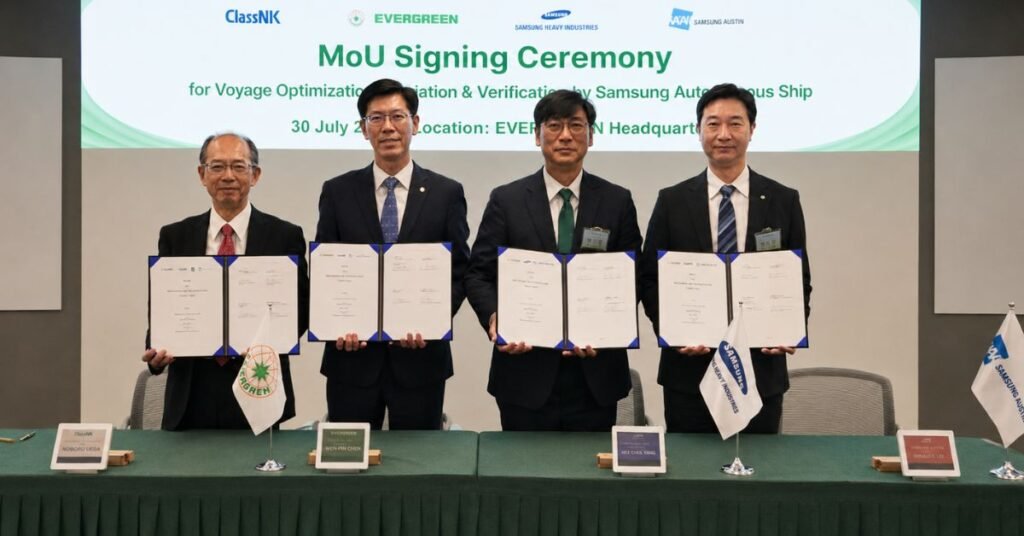
ClassNK has joined Evergreen Marine, Samsung Heavy Industries (SHI) and Weathernews in a joint project to assess the potential of artificial intelligence (AI)-based voyage optimisation to reduce vessel fuel consumption and greenhouse gas (GHG) emissions.
Under a newly signed Memorandum of Understanding (MOU), the companies will conduct a demonstration using an Evergreen-operated commercial vessel under actual operating conditions.
AI voyage optimisation to be tested at sea
The trial will use the Samsung Autonomous Ship (SAS) system developed by Samsung Heavy Industries. The system will provide speed optimisation and real-time vessel control during the demonstration.
Weathernews will supply high-resolution weather and ocean forecasts, develop baseline voyage routes and provide historical data for the analysis.
Evergreen will provide the vessel and operational data required for the trial, including fuel consumption information. The vessel’s crew will also participate in the demonstration and support the operational trials.
The partners will compare vessel performance and operational data to assess the impact of AI-assisted voyage optimisation on fuel consumption and GHG emissions.
ClassNK to independently assess performance
ClassNK will review the methodology used to measure the technology’s performance and independently evaluate the results.
Following the assessment, the classification society will issue a Statement of Fact (SoF) covering the findings of the demonstration.
The evaluation is intended to provide an independent basis for assessing the effectiveness of AI-based voyage optimisation. Fuel savings can be influenced by factors including weather conditions, sea state, vessel condition and operational requirements, making consistent measurement important when evaluating the technology.
Focus on measurable emissions reductions
AI-assisted voyage optimisation is emerging as a potential efficiency measure that can reduce fuel use without requiring immediate changes to a vessel’s fuel or propulsion system.
The project will examine the technology under commercial operating conditions to determine the extent to which AI-driven voyage decisions can improve vessel efficiency.
By combining autonomous vessel technology with real-time and historical weather and ocean data, the participating companies will assess whether optimised routing and speed decisions can reduce fuel consumption and associated GHG emissions.
The project forms part of ClassNK’s efforts to support the practical application of technologies for reducing emissions from maritime transportation.
Recent Posts
Marine
Singapore Unveils Ammonia Bunkering Standard, First Ethanol Bunkering and LNG Storage Plans
Ammonia
Singapore Launches TR 148 Ammonia Bunkering Standard and Model Contract to Prepare for Ammonia-Fuelled Ships
Policy
China Targets Doubling New Energy Inland Vessels by 2028 Under 2026-2030 Action Plan