
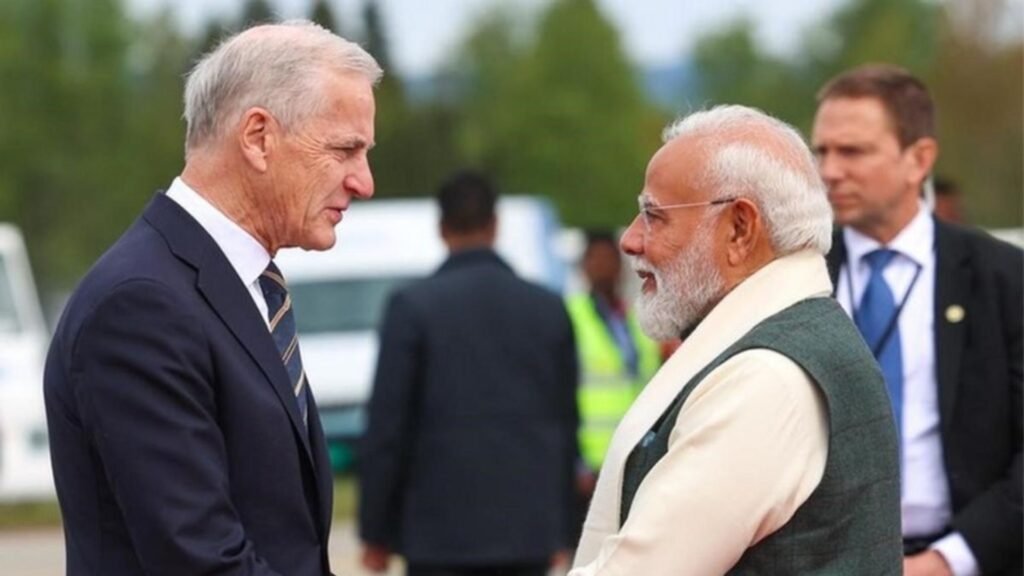
Indian Prime Minister Narendra Modi addressed the India-Norway Business and Research Summit in Oslo, pushing for accelerated Norwegian investment in India under the recently activated trade pact between India and the European Free Trade Association (EFTA).
The summit was attended by Norway’s Crown Prince Haakon and Norwegian Prime Minister Jonas Gahr Støre, alongside chief executives from more than 50 companies and over 250 participants drawn from the business and research communities of both countries.
Inside the Oslo Summit
The gathering followed the entry into force of the India-EFTA Trade and Economic Partnership Agreement (TEPA), which has formed the basis for renewed economic engagement between India and Norway.
Prior to the main summit, four roundtable sessions were held at separate venues across Oslo, covering:
Healthcare innovation
Maritime cooperation
Batteries and energy storage systems
Digitalisation and electrification
Wind energy
A number of business agreements between Indian and Norwegian companies and institutions were signed on the sidelines of the summit, though specifics were not disclosed in the official briefing.
The $100 Billion Ask
Modi called on stakeholders in both countries to work toward the USD 100 billion investment target laid out under TEPA, along with the associated commitment to generate one million jobs in India over the agreement’s implementation period.
He pointed to India’s growth trajectory, demographic profile, regulatory framework, and what he described as “competitive federalism” among Indian states as factors supporting the investment case. The Prime Minister identified the blue economy, shipbuilding, green transition, renewable energy, health-tech, critical minerals, and start-ups as priority sectors for Norwegian capital.
Where the Green Agenda Fits In
A significant portion of Modi’s address focused on India’s energy transition agenda, including expansion in renewable energy capacity, grid infrastructure, green hydrogen, and broader clean energy investment.
He acknowledged Norway’s positioning in clean energy financing, maritime decarbonisation, ocean sustainability, and climate finance — areas where Norwegian firms and sovereign capital have built substantial international exposure.
Why TEPA Is Different
TEPA, which entered into force earlier in 2025, is India’s first trade agreement with a European bloc and is structurally distinct from conventional free trade agreements in that it links tariff concessions to a binding investment commitment from EFTA member states — Norway, Switzerland, Iceland, and Liechtenstein.
The USD 100 billion investment target over 15 years is among the more ambitious investment-linked trade provisions globally, and the one million jobs commitment makes implementation politically visible in India. Norway’s participation is particularly relevant given the size of its sovereign wealth fund — the world’s largest — and the country’s industrial capabilities in shipping, offshore energy, and aquaculture.
From Handshakes to Hard Deals
The Prime Minister urged business communities on both sides to identify fresh areas of collaboration and convert the trade agreement’s framework into concrete commercial activity. The summit forms part of a broader diplomatic push by India to operationalise TEPA commitments, with similar engagement expected with other EFTA partners.
Recent Posts
HYBRID
GRSE Signs ₹1,032-Crore ONGC Contract for Four Hybrid Offshore Supply Vessels
EV
Energy In Motion Opens ₹500-Crore Electric Truck Plant in Pune
Fuels
Aegis Logistics Commissions 35,000-Tonne LPG Bottling Plant at JNPA