
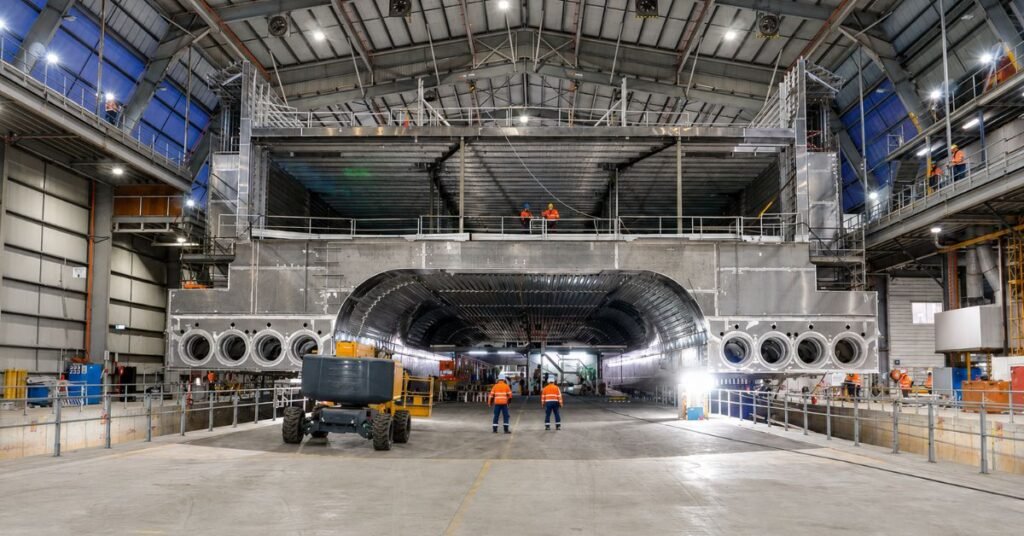
Tasmanian shipbuilder Incat has completed the rollback of Hull 102 at its Prince of Wales Bay shipyard, marking a key construction milestone in a three-vessel battery-electric ferry programme for Danish ferry operator Molslinjen.
The rollback allows work to begin on installing the passenger deck superstructure of the 129-metre electric ferry, the first of three vessels being built for deployment on Denmark’s busy Kattegat routes.
Three-Vessel Programme Targets Emissions-Free Ferry Operations
Hull 102 is the first vessel in a fleet of three battery-electric ferries being constructed by Incat for Molslinjen, which describes the project as one of the world’s largest maritime electrification programmes.
According to Incat, the ferries will be among the largest battery-electric ferries operating in Europe once they enter service.
The first two vessels, currently known as Hull 102 and Hull 103, will each be powered by a 45 MWh battery system.
Each ferry will accommodate up to 1,500 passengers and 500 cars, featuring drive-through loading arrangements designed to minimise turnaround times at port.
High-Speed Electric Ferries for Denmark’s Kattegat Route
The vessels are designed to operate at speeds of up to 40 knots, serving the 90-minute crossings between Aarhus–Odden and Ebeltoft–Odden, linking Denmark’s Jutland and Zealand regions.
Charging infrastructure capable of delivering 58 MW of power will enable each ferry to recharge during approximately 30-minute port stays, supporting continuous electric operations.
Fleet Expansion Follows Initial Two-Vessel Order
Parent company Nordic Ferry Infrastructure placed the original DKK 1 billion (approximately US$157 million) order for two battery-electric catamarans in July 2025.
A third vessel was subsequently added to the programme in December 2026, bringing the total investment for the three ferries and associated charging infrastructure to approximately DKK 3.5 billion (US$546 million).
Molslinjen said the introduction of the three vessels will enable its entire Kattegat ferry operation to become emissions-free once the fleet enters service.
According to the company’s deployment schedule:
- First ferry: Expected to enter service at the end of 2027
- Second ferry: Scheduled for mid-2028
- Third ferry: Planned for early to mid-2029
Recent Posts
Biofuels
WinGD Ethanol-Fuelled Engine Completes First In-Service Voyage on Maersk Vessel
Power & Propulsion
Norsepower Rotor Sails Installed on Airbus Cargo Ship Spirit of Toulouse
EV
Estonia Electric Ferry to Combine Steerprop Propulsion with Battery Power