
Summary
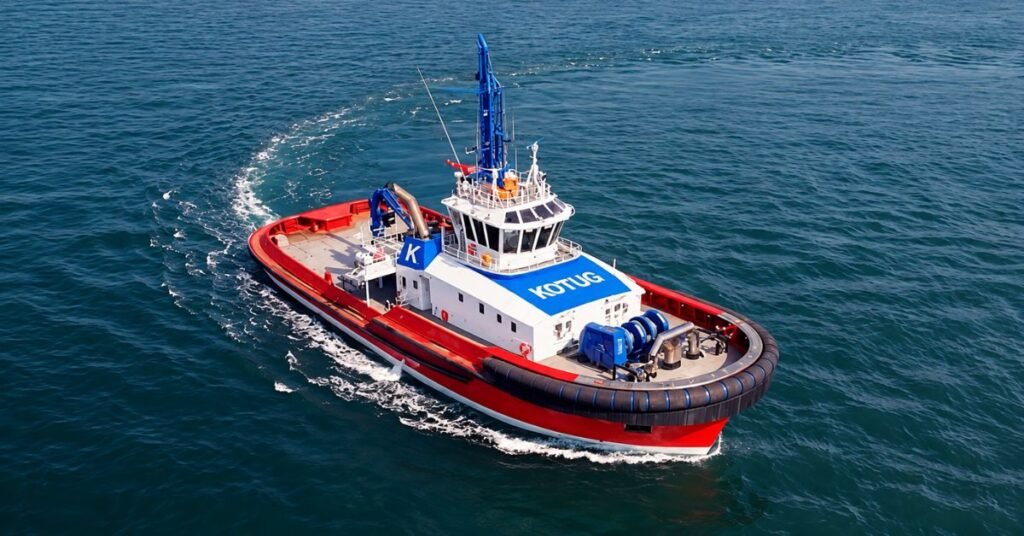
Kotug Canada’s SD Aisemaht has arrived in British Columbia, bringing dual-fuel methanol technology to its tanker escort programme. Built by Sanmar in Turkey, the vessel combines powerful towage capability with firefighting and oil-spill response equipment. Its sister tug remains in Turkey undergoing final preparations for delivery.
Arrival advances Canada’s methanol tug programme
The methanol escort tug SD Aisemaht has reached British Columbia after a delivery voyage from Turkey, marking a milestone in Kotug Canada’s fleet renewal programme for tanker operations supporting the Trans Mountain export system.
The vessel was recorded near Victoria on October 7 and Nanaimo on October 9. Its arrival follows a voyage across the Atlantic and onward to Canada’s Pacific coast.
Kotug Canada, a joint venture between Kotug International and Horizon Maritime, commissioned two 44-metre vessels from Sanmar Shipyards. Both use Canadian naval architect Robert Allan Ltd’s RAsalvor 4400-DFM design.
SD Aisemaht is the first of the pair to arrive. Its sister vessel, SD Qwiy Aanitsa Sarah, remained at Yalova in Turkey for final commissioning, classification and sea trials.
The tugs are intended to escort Aframax tankers along an approximately 150-nautical-mile route through the Salish Sea and Juan de Fuca Strait to the Pacific Ocean.
Purpose-built vessels combine power and fuel flexibility
Kotug describes the pair as the world’s first large, purpose-built dual-fuel methanol escort tugs. Their design combines alternative-fuel capability with the substantial towing power required for loaded tanker escorts.
The vessels’ engines can operate on diesel or methanol, giving the operator flexibility as alternative-fuel supply develops. Kotug says renewable methanol can deliver substantial carbon dioxide reductions, making fuel sourcing an important part of the project’s environmental performance.
The propulsion architecture also incorporates shaft alternators, emissions-control equipment and energy-management systems. These features address both fuel choice and how efficiently onboard machinery operates.
The project therefore combines a change in fuel capability with measures intended to reduce energy consumption during routine operations. Methanol capability alone does not establish the vessels’ actual emissions performance, which will depend on the fuel used and operating conditions.
Mechanical hybrid system targets transit efficiency
Each tug is equipped with two Schottel SRP 710 rudderpropellers and an STT 170 transverse thruster. The steerable main propulsion units provide manoeuvrability for escort work, while the additional thruster supports positioning.
Schottel’s SYDRIVE-M mechanical hybrid arrangement allows one main engine to drive both azimuth thrusters during suitable operations. This reduces the need to run two engines when the vessel’s power demand is lower.
The supplier says the arrangement can reduce engine operating hours, maintenance requirements and fuel consumption. It achieves the mechanical connection without requiring additional electrical propulsion components.
This is particularly relevant to escort duties, where a tug must retain substantial power for demanding manoeuvres but also undertake transit periods at lower loads.
Both hulls feature graphene coatings intended to limit biofouling and improve surface smoothness. Schottel associates these measures with better fuel efficiency and reduced underwater noise, an important consideration in the Salish Sea’s sensitive marine environment.
Certification covers escort and emergency duties
Sanmar announced full ABS classification for SD Aisemaht on May 26, 2026. The certification includes towing and escort vessel notations, with a recorded bollard pull of 115.12 tonnes.
Bollard pull measures a tug’s pulling force under stationary conditions and provides an important indication of its towing capability.
The vessel also holds firefighting and oil-spill response notations, alongside classification provisions for methanol dual-fuel operation. Sanmar stated that it complies with IMO Tier III emissions standards.
Its classification package includes environmental and sustainability notations, underwater inspection provisions and accommodation-related requirements. Together, these cover a vessel designed for several responsibilities beyond routine towage, including emergency response and extended operational readiness.
Project builds on existing escort services
Kotug Canada’s Trans Mountain escort service predates the new vessels. In May 2025, the company marked the first anniversary of operations under its long-term contract supporting tankers departing Westridge Marine Terminal in Burnaby.
The methanol vessels were planned to replace the existing escort tugs serving that programme.
A further element is the partnership with the Sc’ianew First Nation at Beecher Bay. Kotug identified Cheanuh Marina as the planned operating base and described arrangements involving economic participation, training and employment opportunities.
That partnership connects fleet investment with local marine stewardship. SD Aisemaht’s arrival now brings the programme closer to deployment, although arrival itself does not confirm the start of commercial methanol-fuelled escort operations.
FAQs
Who will operate SD Aisemaht?
Kotug Canada, a joint venture between Kotug International and Horizon Maritime.
Who built and designed the tug?
Sanmar Shipyards built it in Turkey to Robert Allan Ltd’s RAsalvor 4400-DFM design.
Can the tug operate on both methanol and diesel?
Yes. Its dual-fuel engines support both fuels.
What is its towing capability?
Sanmar reported an ABS-classified bollard pull of 115.12 tonnes.
Has the second tug arrived in Canada?
As of the October 10 update, SD Qwiy Aanitsa Sarah remained in Turkey undergoing final preparations.
Recent Posts
Bunkering
SLNG third jetty to expand Singapore’s LNG bunker reload capacity
Biofuels
DSV Signs Up for CMA CGM ACT+ to Cut 12,000 Tonnes of CO2 with UCOME Biofuel
Technology
Sagar Defence and Lloyd’s Register Partner on Autonomous Maritime Systems Certification