
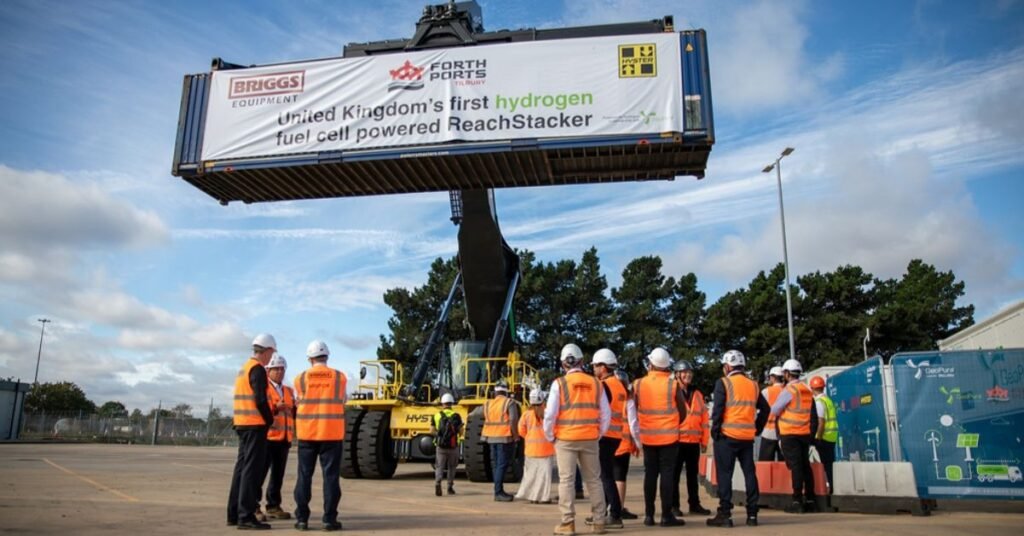
The Port of Tilbury has begun live operational testing of a hydrogen fuel cell-powered Hyster reachstacker, marking the deployment of Britain’s first hydrogen fuel cell container reachstacker in a pre-production port trial.
The project is assessing whether hydrogen fuel cell propulsion can provide the operating performance, endurance and reliability required for heavy container-handling operations in a UK port environment.
Hydrogen Reachstacker Designed for 12-Hour Shifts
The Hyster reachstacker combines a 60kW Nuvera fuel cell with a 130kWh lithium-ion battery and carries 32kg of hydrogen. The machine is designed to operate for up to 12 hours and can be refuelled in less than 30 minutes.
The shorter refuelling period is intended to reduce energy-replenishment downtime compared with the longer charging periods associated with some battery-electric heavy handling equipment.
At Tilbury, the machine is being supplied with green hydrogen produced and dispensed through on-site infrastructure provided by GeoPura.
Hyster estimates that replacing an equivalent diesel-powered duty could reduce tank-to-wheel carbon dioxide emissions by more than 107,000kg annually. The estimate is based on diesel consumption of 40,000 litres per year and approximately 2,500 operating hours.
Hyster and Partners Develop Port Trial
The reachstacker was developed through collaboration between Hyster, authorised dealer Briggs Equipment UK, Nuvera and the Port of Tilbury.
Hyster has also incorporated experience from an earlier hydrogen fuel cell reachstacker pilot in Valencia, using findings from that programme to refine and resize the system before deploying the machine at Tilbury.
Briggs Equipment will provide frontline maintenance under the existing equipment support arrangement at the port. Hyster’s factory team will provide additional support for the fuel cell and high-voltage systems through its Hypercare programme.
Hydrogen and Battery-Electric Systems Tested Separately
The Tilbury trial forms part of Hyster’s wider work on alternative power systems for heavy handling equipment. In the Netherlands, the company has separately begun a two-year field programme involving a battery-electric RSJ46-33XDL reachstacker at Inland Terminals Group’s Venray-Wanssum operation.
That machine uses four 130kW lithium-ion battery packs designed around an eight-hour shift. In contrast, the Tilbury configuration uses a smaller traction battery supported by electricity generated through hydrogen fuel cells.
Live Operations to Generate Performance Data
Reachstackers present a demanding application for alternative power systems because their energy requirements vary continuously. Machines must accelerate, travel across yards, lift and extend their booms, handle containers of different weights and repeatedly reposition during cargo operations.
The Port of Tilbury handles around 16 million tonnes of cargo annually and has approximately five million square feet of warehousing. Its operations include containers, RoRo, construction materials, grain, paper, automotive cargo and other industrial flows.
The trial will collect operational data covering shift endurance, refuelling reliability, servicing requirements, uptime, energy consumption and machine productivity. The results will help assess whether hydrogen-powered heavy handling equipment can progress from pre-production testing to a repeatable procurement option for high-intensity terminal operations.
Recent Posts
Ammonia
Aegis Tristar acquisition to expand Indian group’s global energy logistics reach
Power & Propulsion
Everllence and MITSUI E&S Mark 100 Years of Two-Stroke Engine Partnership
Ammonia
NTPC Targets Japan, South Korea and Germany for Green Ammonia Exports from Andhra Pradesh Hub