
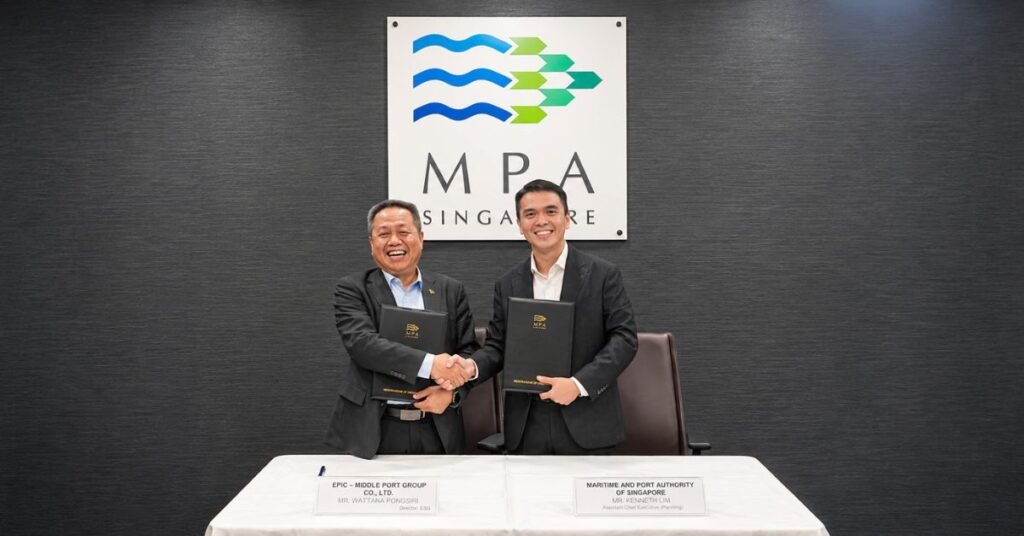
The Maritime and Port Authority of Singapore (MPA) and Qingdao Port have agreed to explore alternative-fuel bunkering demonstrations on direct shipping routes between the two ports. Announced by MPA on 4 November 2026, the work plan covers marine fuels, digital information exchange and joint research.
The agreement advances the Singapore–China and Singapore–Shandong Green and Digital Shipping Corridors. It was signed by MPA Chief Executive Ang Wee Keong and Qingdao Port Group Chairman Su Jianguang, with Shandong Port Group Chairman and General Manager Gao Liping attending.
What will the bunkering cooperation cover?
The partners will examine pilot projects involving zero- and near-zero greenhouse gas emission marine fuels, including methanol. They will also study pooling methanol bunkering demand and share knowledge on fuel-transfer standards and operating procedures.
The digital workstream will exchange vessel operational event data through existing infrastructure, including MPA’s OCEANS-X platform, to improve arrival visibility, berth planning and resource allocation.
Research cooperation will involve organisations such as the Singapore Maritime Institute and China Waterborne Transport Research Institute, covering alternative fuels and maritime digitalisation.
How does the work plan build on earlier corridor agreements?
Singapore and Shandong established their Green and Digital Shipping Corridor through a memorandum of understanding signed on 9 October 2024.
That agreement brought together MPA and the Shandong Provincial Transport Department, with cooperation extending to maritime administrations, port operators, shipping companies, educational institutions and shipyards.
Its priorities included training for the safe handling of alternative fuels, shore-power knowledge exchange, digital information sharing for port clearances, and common operating practices. Qingdao forms part of Shandong’s coastal cluster of major ports and shipbuilding facilities, linking the provincial initiative with the Bohai and Yellow Sea region.
Cooperation subsequently expanded to the national level. Singapore’s and China’s transport ministries signed a further memorandum on 19 October 2025, establishing the Singapore–China Green and Digital Shipping Corridor.
The national framework builds on the earlier Tianjin and Shandong arrangements. It encompasses maritime decarbonisation, port and supply-chain efficiency, and the development of supporting infrastructure, technologies and standards. It also promotes data-driven systems across maritime transport operations.
What methanol bunkering arrangements are already in place?
Singapore’s methanol supply framework provides an established basis for the planned technical exchanges.
MPA opened applications for methanol bunker supplier licences in March 2025, covering a licensing period from 1 January 2026 to 31 December 2030. The framework incorporated feedback from more than 50 proposals submitted through an earlier expression-of-interest exercise, together with experience from methanol bunkering trials and operations conducted since 2023.
Singapore also introduced Technical Reference 129 on methanol bunkering in 2025. Developed through MPA, Enterprise Singapore and the Singapore Standards Council, it provides a framework for safe and efficient methanol fuel-transfer operations. Such operating standards are directly relevant to the knowledge-sharing envisaged between Singapore and Qingdao.
Qingdao has meanwhile begun building practical experience. The port handled its first methanol bunkering operation in August 2025, supplying 200 tonnes to COSCO Shipping Carnation. In July 2026, the 24,000-twenty-foot-equivalent-unit container vessel OOCL Wisdom received 1,500 tonnes of green methanol through a ship-to-ship operation.
The proposed corridor pilots would build on these activities. Their commencement dates remain to be specified, while the demand-pooling studies will examine how methanol requirements on the direct route could be coordinated.
Recent Posts
Marine
Petrobras advances Tupi Field redevelopment with LR approval for FPSO concept
Power & Propulsion
Wärtsilä secures engine and propulsion order for Delfin LNG’s first FLNG vessels
Marine
StormGeo and CCS link emissions platforms to support digital verification in China