
Summary
Cochin Shipyard has commenced steel cutting for three battery-electric harbour tugs ordered by Denmark-based towage operator Svitzer. The 26-metre TRAnsverse 2600e vessels, each designed for a bollard pull of 70 tonnes, form part of a four-tug contract with options for four additional vessels. The project expands the Indian shipbuilder’s role in electric tug construction as the maritime industry explores lower-emission solutions for port operations.
Steel Cutting Advances Construction of Three Electric Tugs
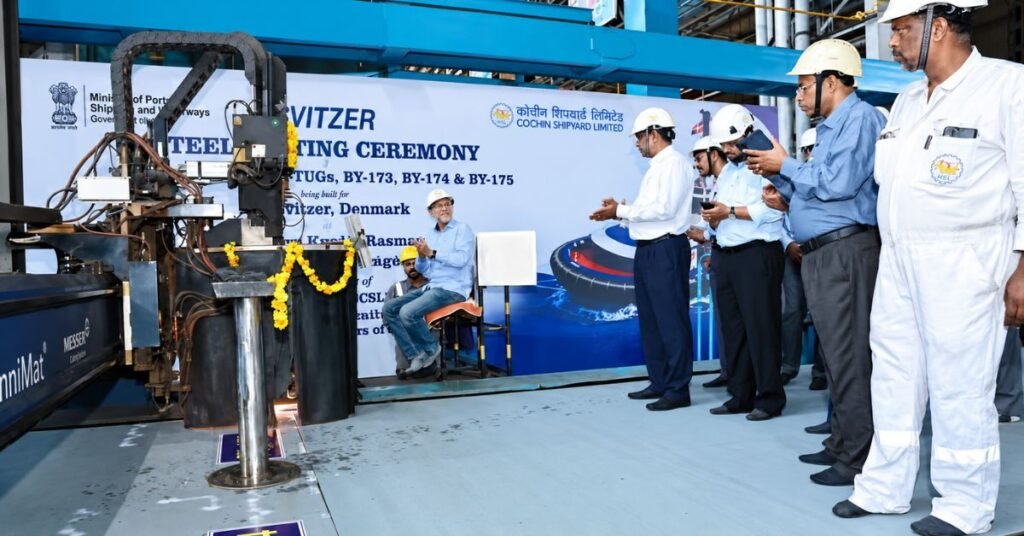
Cochin Shipyard has started steel cutting for three battery-electric harbour tugs, identified as BY-173, BY-174 and BY-175, at its facilities in Kochi. The vessels are being built for Svitzer as part of the towage operator’s fleet development programme.
The steel-cutting ceremony was led by Jens Ove Kymler Rasmussen, Svitzer’s newbuilding site manager. The milestone marks the start of steel fabrication for the three vessels and advances construction under the contracted programme.
Each tug is designed to deliver a bollard pull of 70 tonnes. The vessels are intended for harbour and terminal operations, including assisting ships in confined waters and manoeuvring vessels in challenging weather and tidal conditions.
Four-Tug Contract Includes Options for Additional Vessels
The construction activity forms part of an agreement signed on 8 December 2025, covering a minimum of four 26-metre TRAnsverse 2600e battery-electric tugs. The contract also includes options for up to four additional vessels.
The agreement followed a Letter of Intent signed during India Maritime Week in October 2025. Under the arrangement, Cochin Shipyard was selected to construct the vessels to Svitzer’s specifications for its international fleet.
The original contract announcement indicated that delivery of the first tug was targeted no earlier than late 2027 or early 2028, subject to design completion, shipyard scheduling and regulatory approvals. No revised delivery timeline has been confirmed in the latest construction update.
A construction ceremony in September 2026 had already marked the steel cutting of the first vessel in the series. The latest milestone extends the programme to the three additional hulls identified as BY-173, BY-174 and BY-175.
Battery-Electric Propulsion Targets Zero Direct Operating Emissions
The TRAnsverse 2600e is the battery-electric variant of Svitzer’s harbour tug design. The vessels are intended to combine towing performance with the manoeuvrability required for ship-assistance operations in restricted port environments.
Battery-electric propulsion can eliminate direct exhaust emissions during operations powered by onboard batteries. The overall emissions benefits depend partly on the electricity used for charging, with renewable electricity offering further potential to reduce the vessels’ lifecycle emissions.
Svitzer has also highlighted the operational experience of the broader TRAnsverse design family. At the September 2026 construction ceremony, the company reported that the wider class had completed more than 3,000 commercial towage jobs. This figure relates to the design family and does not represent the operating record of the newly commissioned electric tugs.
The project involves integrating electric propulsion and onboard systems with the shore-side infrastructure needed to support charging and vessel deployment.
Project Expands India’s Electric Tug-Building Experience
Svitzer selected Cochin Shipyard following an international evaluation of shipyards. The contract connects the Indian shipbuilder with the technical and production requirements of an overseas towage operator developing its fleet.
The programme also provides an opportunity to build domestic experience in electric propulsion systems and specialised harbour vessel construction. However, the ports where the four tugs will ultimately be deployed have not been confirmed in the announcements reviewed.
The project is separate from India’s domestic Green Tug Transition Programme, although both involve the development of capabilities relevant to the adoption of lower-emission harbour vessels.
Green Tug Transition Programme Sets Domestic Policy Direction
India’s Green Tug Transition Programme provides the policy backdrop for the expansion of green tug construction. Operating procedures for the programme were launched in August 2024, with its first phase scheduled to run from October 2024 to December 2027.
During this phase, Jawaharlal Nehru Port Authority, Deendayal Port Authority, Paradip Port Authority and V.O. Chidambaranar Port Authority are each expected to procure or charter at least two green tugs. Battery-electric propulsion is envisaged for the initial vessels, with scope for other emerging technologies.
The programme requires participating tugs to be built at Indian shipyards and envisages the transition to green tugs across major ports by the end of 2040.
Although the Svitzer contract is a separate commercial undertaking, its construction activity contributes to the Indian shipbuilding sector’s experience with electric harbour vessels.
FAQs
How many electric tugs are being built for Svitzer at Cochin Shipyard?
The latest steel-cutting milestone covers three vessels, identified as BY-173, BY-174 and BY-175. They form part of a contract for at least four battery-electric tugs.
What are the specifications of the TRAnsverse 2600e tugs?
Each tug is 26 metres long and designed for a bollard pull of 70 tonnes. The vessels use battery-electric propulsion and are intended for harbour towage and ship-assistance operations.
How many vessels does the Svitzer contract cover?
The agreement covers a minimum of four battery-electric tugs, with options for up to four additional vessels.
When is the first Svitzer electric tug expected to be delivered?
The original contract announcement targeted the first delivery no earlier than late 2027 or early 2028. The timeline remains subject to design completion, shipyard scheduling and regulatory approvals.
How does the project relate to India’s Green Tug Transition Programme?
The Svitzer order is a separate commercial contract, but it supports the development of Indian shipbuilding experience in electric tug construction, a capability relevant to the country’s wider transition towards lower-emission port operations.
Recent Posts
Bunkering
SLNG third jetty to expand Singapore’s LNG bunker reload capacity
Biofuels
DSV Signs Up for CMA CGM ACT+ to Cut 12,000 Tonnes of CO2 with UCOME Biofuel
Technology
Sagar Defence and Lloyd’s Register Partner on Autonomous Maritime Systems Certification