
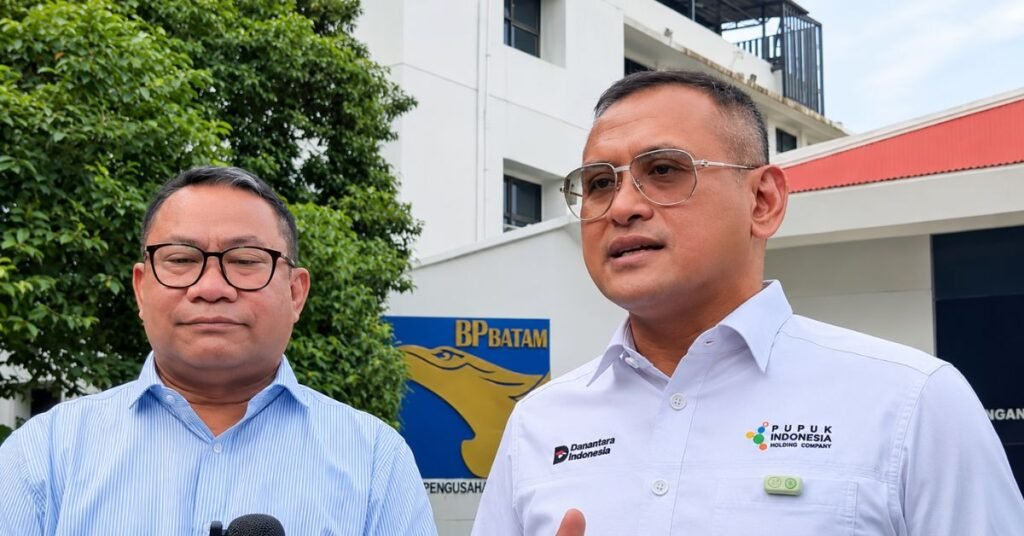
Pupuk Indonesia is exploring an ammonia hub in Batam, Indonesia, with an estimated investment of up to US$500 million, combining production and distribution with potential marine fuel supply. The state-owned company outlined the proposal on 4 November 2026, following discussions with the Batam Indonesia Free Zone Authority, known as BP Batam.
The proposed development would serve domestic industry and export customers while positioning Batam to participate in the emerging ammonia bunkering market. Pupuk Indonesia is assessing natural gas supplies from Natuna and Grissik as potential feedstock.
What would the Batam ammonia hub include?
The project envisages integrated facilities for ammonia production, bunkering, distribution and trading. It would build on Pupuk Indonesia’s existing ammonia production capacity of approximately 7.1 million tonnes annually.
President Director Rahmad Pribadi and company representatives met BP Batam Head Amsakar Achmad on 2 November in Batam, Riau Islands, to discuss the opportunity.
Rahmad said Indonesia could draw on Singapore’s experience in developing maritime services while using domestic resources to create additional industrial value. He also emphasised that Pupuk Indonesia remained open to collaboration with partners.
The company’s proposal links established industrial demand for ammonia with the prospect of supplying it as a shipping fuel.
What must happen before construction begins?
Site selection and feedstock availability remain central to the project’s development. Pupuk Indonesia is evaluating potential locations, taking account of land suitability and the area’s longer-term development plans.
BP Batam Deputy for Investment Fary Djemy Francis said the authority would facilitate land allocation and licensing. A joint team would support implementation once the project reached the investment-ready stage.
Construction is estimated to require approximately three years after land and raw material requirements have been secured. This is a prospective construction period, with the start dependent on those prerequisites.
Rahmad separately indicated that the company intended to finance the plant through internal funds. He estimated that construction could employ up to 8,000 workers. Both the employment figure and investment requirement relate to the proposed development.
How is the regional ammonia bunkering market developing?
The Batam proposal comes as neighbouring Singapore establishes operating arrangements for ammonia fuel supply.
On 14 October 2026, the Maritime and Port Authority of Singapore (MPA) and Enterprise Singapore, through the Singapore Standards Council, introduced Technical Reference 148:2026, a code of practice for ammonia bunkering.
The framework covers fuel custody transfer, bunkering procedures, safety and personnel competency. It provides guidance for suppliers, bunker vessel operators, shipowners and other participants preparing for ammonia operations.
MPA and Australia’s Pilbara Ports Authority will also share operational experience and information from bunkering trials to help validate the framework under the Singapore–Australia Green and Digital Shipping Corridor. These activities illustrate the operational preparation accompanying investment in alternative-fuel supply infrastructure.
Production technology will determine the fuel’s emissions profile
The Batam proposal identifies natural gas as its prospective feedstock. The eventual emissions performance of its ammonia will therefore depend on the production process and any measures adopted to manage associated carbon emissions.
The International Energy Agency’s ammonia technology roadmap identifies several pathways towards near-zero-emission production. These include hydrogen produced through electrolysis and fossil-based production incorporating carbon capture and storage.
For natural gas-based ammonia, the agency highlights the importance of capturing carbon dioxide from production and energy use, with performance dependent on capture rates and permanent storage. These production choices will be relevant to the project’s potential role in supplying lower-emission marine fuel.
Recent Posts
Marine
Petrobras advances Tupi Field redevelopment with LR approval for FPSO concept
Power & Propulsion
Wärtsilä secures engine and propulsion order for Delfin LNG’s first FLNG vessels
Marine
StormGeo and CCS link emissions platforms to support digital verification in China